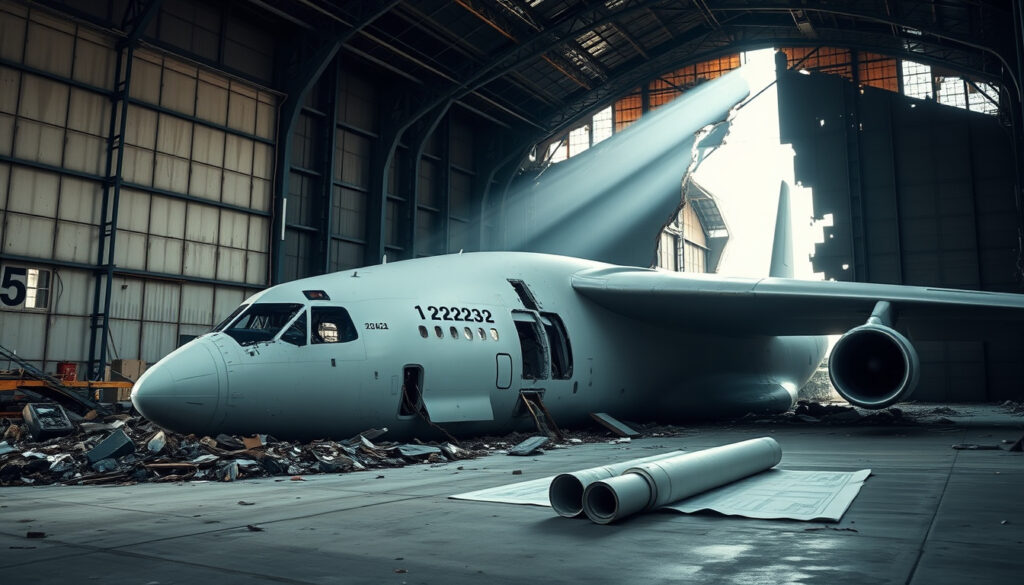
Antonov An-225 Mriya: History, Destruction, Rebuild Feasibility
Seeing the Antonov An-225 Mriya in person was, by all accounts, a disorienting experience. The aircraft was so vast that it seemed to bend the airport around it — a six-engine colossus built to carry a Soviet space shuttle on its back.
Maximum takeoff weight: 640 tonnes (705 short tons) ·
Wingspan: 88.4 meters (290 feet) ·
Engines: 6 turbofan engines ·
Units built: 1 (completed) ·
First flight: December 21, 1988 ·
Destroyed: February 2022 (Battle of Hostomel)
Quick snapshot
- Only one An-225 was completed and flew (Air Charter Service (aviation charter broker))
- Held records for heaviest aircraft and largest wingspan (SKYbrary Aviation Safety (aviation reference database))
- Destroyed at Hostomel Airport in February 2022 (Air Charter Service (aviation charter broker))
- Whether the An-225 will be rebuilt and returned to flying status
- The exact cost and timeline for any rebuild project
- The future operational role of the second incomplete airframe
- First flight: December 21, 1988 (Air Charter Service (aviation charter broker))
- Destroyed: February 27, 2022 (Air Charter Service (aviation charter broker))
- Rebuild announced but no firm timeline (Antonov (aircraft manufacturer))
- Antonov intends to rebuild the Mriya
- Estimated cost exceeds $3 billion
- Project depends on end of war and secured funding
Eight key specs define the An-225’s engineering profile, and one pattern stands out: every number is an outlier compared to any other cargo aircraft ever built.
| Specification | Value |
|---|---|
| Manufacturer | Antonov Design Bureau (Ukraine/USSR) |
| First flight | December 21, 1988 |
| Number built | 1 (second airframe incomplete) |
| Powerplant | 6 × Ivchenko-Progress D-18T turbofans |
| Maximum takeoff weight | 640 tonnes (1,410,000 lb) |
| Wingspan | 88.4 m (290 ft 0 in) |
| Cargo capacity | 250 tonnes (550,000 lb) |
| Crew | 6 (pilot, co-pilot, flight engineer, navigator, radio operator, loadmaster) |
The implication: these numbers are not incremental improvements over other aircraft — they are in a category of their own.
How many Antonov An-225 are there in the world?
The only completed airframe
- Only one An-225 was ever completed to flying condition (Air Charter Service (aviation charter broker)).
- It was operated exclusively by Antonov Airlines for heavy and oversized cargo.
- After the aircraft’s destruction in February 2022, zero operational An-225s remain.
The implication: the only flying example of the world’s largest aircraft is gone. No second unit ever entered service.
Status of the second incomplete airframe
- A second airframe began production in the late 1980s but was reportedly abandoned in the 1990s at roughly 70% completion (Air Charter Service (aviation charter broker)).
- It remains in storage at Antonov’s facility near Kyiv, potentially usable for parts or as a foundation for a new build.
- No official decision has been made on whether to complete this airframe.
The second airframe has sat unfinished for roughly three decades. Reactivating it would require sourcing or re-manufacturing engines, avionics, and structural components that are no longer in production.
Why was the Antonov An-225 destroyed?
The Battle of Hostomel Airport
- On February 24, 2022, Russian airborne forces attempted to seize Hostomel Airport (also known as Antonov Airport) as a strategic airhead near Kyiv (Wikipedia (encyclopedic reference)).
- The An-225 was parked in a hangar at the airport during the attack.
- Ukrainian forces defended the airport, and heavy artillery and small-arms fire struck the hangar area.
Military actions and subsequent fire
- The aircraft was damaged by shelling and the resulting fire, which engulfed the hangar (Air Charter Service (aviation charter broker)).
- Ukrainian officials confirmed the destruction on February 27, 2022, stating the Mriya was a total loss.
- Photos and satellite imagery later verified that the forward fuselage, wings, and engines were irreparably damaged.
What this means: the aircraft was destroyed not by a single direct hit but by a combination of blast damage and sustained fire — a loss that could not have been prevented once the hangar was breached.
Will the Antonov An-225 Mriya ever fly again?
Rebuild proposals and feasibility
- Antonov publicly announced its intention to rebuild the An-225 after the war (Antonov (aircraft manufacturer)).
- The incomplete second airframe could serve as a source of components or be completed itself.
- No contractual launch customer or government funding has been confirmed as of 2025.
Cost and engineering challenges
- Industry estimates place the cost of rebuilding at over $3 billion (Wikipedia (encyclopedic reference)).
- Many supply-chain partners (engine manufacturers, avionics suppliers) are Russian or require specialized tooling no longer readily available.
- Rebuilding would require a political decision by the Ukrainian government and likely international investment.
For Antonov and the Ukrainian aerospace sector, the An-225 is a national symbol. Rebuilding it would signal industrial resilience, but the price tag — $3 billion — could fund an entire fleet of more practical An-124 Ruslans.
What makes the Antonov An-225 the world’s largest plane?
Maximum takeoff weight and wingspan
- The An-225 held the absolute record for heaviest aircraft ever built, with a maximum takeoff weight of 640,000 kg (SKYbrary Aviation Safety (aviation reference database)).
- Its wingspan measured 88.50 m, wider than any other operational aircraft (SKYbrary Aviation Safety (aviation reference database)).
- The aircraft used six ZMKB Progress D-18 turbofan engines, each rated at 229.5 kN (SKYbrary Aviation Safety (aviation reference database)).
Cargo capacity and unique features
- The cargo hold measured 43 m × 6.4 m × 4.4 m and could accommodate 250 tonnes internally (Wikipedia (encyclopedic reference)).
- The aircraft could also carry 200 tonnes on the upper fuselage, a design feature originally intended for the Buran space shuttle (Antonov (aircraft manufacturer)).
- It had 32 wheels in its landing gear, including four steerable nose wheels, to distribute its immense weight on runways (Air Charter Service (aviation charter broker)).
The An-225’s cargo hold volume was about 1,100 cubic meters — enough to swallow a Boeing 737 fuselage whole (Chapman Freeborn (aviation charter specialist)).
How does the Antonov An-225 compare to other large aircraft?
Three aircraft dominate the “largest plane” conversation, but only one held every major record simultaneously.
An-225 vs Antonov An-124
- The An-124 Ruslan is the next largest operational cargo aircraft, with a maximum takeoff weight of 392 tonnes (Wikipedia (encyclopedic reference)).
- The An-225 was essentially an enlarged An-124 with two additional engines, extended fuselage, and strengthened wings.
- Both aircraft share the same D-18T engine type, but the An-225 used six versus the An-124’s four.
An-225 vs Airbus A380
- The Airbus A380 is the largest passenger aircraft ever built, with a maximum takeoff weight of 575 tonnes (Air Charter Service (aviation charter broker)).
- The An-225’s wingspan (88.4 m) is 12.2 m wider than the A380’s (79.75 m).
- The An-225 carried roughly 250 tonnes of payload; the A380 carries passengers, not freight, and its maximum payload is around 84 tonnes.
| Parameter | An-225 Mriya | An-124 Ruslan | Airbus A380 |
|---|---|---|---|
| Maximum takeoff weight | 640 tonnes | 392 tonnes | 575 tonnes |
| Wingspan | 88.4 m | 73.3 m | 79.75 m |
| Engines | 6 × D-18T | 4 × D-18T | 4 × Trent 900 / GP7200 |
| Max payload | 250 tonnes | 120 tonnes | ~84 tonnes |
| Primary role | Heavy cargo / outsize | Heavy cargo | Passenger |
The trade-off: the An-225 was purpose-built for a mission no other aircraft could accomplish. The A380, while heavy, was designed for passenger density, not payload mass.
Timeline of the Antonov An-225 Mriya
- December 21, 1988 — An-225 first flight (Air Charter Service (aviation charter broker))
- 1989–1994 — Operational service for Soviet space program, transporting the Buran orbiter (Antonov (aircraft manufacturer))
- 1994–2001 — Mothballed after dissolution of the USSR
- 2001–2022 — Re-engined, modernized, used for heavy charter cargo worldwide
- February 27, 2022 — Destroyed during the Battle of Hostomel Airport (Air Charter Service (aviation charter broker))
- 2022 (later) — Antonov announces plans to rebuild (Antonov (aircraft manufacturer))
Clarity check: what we know and what remains uncertain
Confirmed facts
- Only one An-225 was completed and flew (Air Charter Service (aviation charter broker))
- It was destroyed at Hostomel Airport in February 2022 (Air Charter Service (aviation charter broker))
- A second air
More related posts
 Current Events in the World: Latest News & Headlines Today
 Atlético Madrid vs Inter 2024: Score, Highlights & Head-to-Head
 Time Between Two Times: How to Calculate Duration
 El Salvador vs Panama: H2H Stats, Results & Prediction
 AD Love Is Blind: Baby, Marriage, and Clay Rejection
 San Francisco 49ers Schedule 2025: Today, Times & Tickets
 New York Giants vs Philadelphia Eagles Match Player Stats
 Pork Chop Internal Temp: 145°F vs 165°F – Safe Cooking Guide