Letter from Birmingham Jail – Context, Arguments and Legacy
In April 1963, while imprisoned in Birmingham, Alabama, Martin Luther King Jr. composed one of the most influential documents of the American civil rights era. The Letter from Birmingham Jail addressed criticism from eight white clergymen and articulated a moral defense of nonviolent resistance that continues to resonate in discussions of justice, law, and civil disobedience.
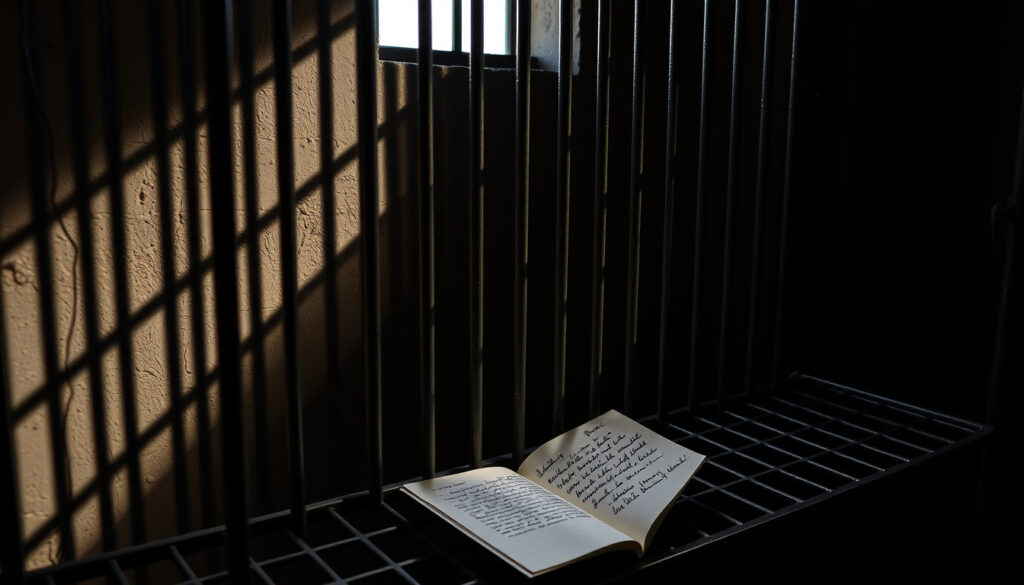
Written on scraps of paper, newspaper margins, and a legal pad over several days, the open letter challenged both the methods and the motivations of those who urged patience over action. Its arguments drew on philosophy, history, and theology to distinguish between just and unjust laws, and to argue that injustice anywhere threatens justice everywhere.
The letter went beyond a personal rebuttal. It became a foundational text in the philosophy of civil disobedience, cited in legal scholarship, taught in classrooms worldwide, and recognized as a milestone in the fight against segregation in the United States.
What is the Letter from Birmingham Jail?
The Letter from Birmingham Jail is an open letter dated April 16, 1963, addressed to “My Dear Fellow Clergymen.” Martin Luther King Jr. composed it while held in solitary confinement in Birmingham’s jail, responding point by point to a public statement titled “A Call for Unity,” published on April 12 in the Birmingham News by eight white Alabama clergymen.
Martin Luther King Jr.
April 16, 1963
Eight white Birmingham clergymen
Nonviolent direct action against unjust laws
The clergymen’s statement had labeled King’s nonviolent protests “unwise and untimely” and urged that grievances be pursued through federal courts rather than street demonstrations. They also described King as an “outsider.” The letter was King’s methodical, patient, and deeply philosophical response.
The document was first published in June 1963 and subsequently circulated widely in various publications. It has since been reprinted in academic anthologies, legal texts, and historical collections as a primary source on civil disobedience and moral reasoning.
- Defends nonviolent direct action as a legitimate response to segregation and racial injustice
- Introduces the moral distinction between just and unjust laws, drawing on Thomistic philosophy
- Critiques white moderates who prioritize order over justice and urge gradual change
- Challenges the church and religious institutions for their silence on racial oppression
- Argues that freedom is never voluntarily given by the oppressor and must be demanded
- Emphasizes interconnectedness of justice — injustice anywhere threatens justice everywhere
- Rivals the “I Have a Dream” speech in rhetorical power and lasting influence
| Fact | Detail |
|---|---|
| Length | Approximately 7,000 words |
| Written on | Scraps of paper, newspaper margins, a legal pad |
| Drafting period | April 12–16, 1963 |
| Arrest date | April 12, 1963 |
| First published | June 1963 as “Letter from Birmingham Jail” |
| Response to | “A Call for Unity” statement by eight white clergymen |
Who Wrote the Letter from Birmingham Jail and Why?
The Author: Martin Luther King Jr.
Martin Luther King Jr. was president of the Southern Christian Leadership Conference (SCLC) at the time of his arrest. He had come to Birmingham at the invitation of local affiliates, including the Alabama Christian Movement for Human Rights, to support their ongoing campaign against segregation in one of the most brutally divided cities in the American South.
King’s credentials as a clergyman gave particular weight to his response. Addressing eight fellow clergymen, he was able to speak within their own theological framework, citing St. Augustine, Thomas Aquinas, and Reinhold Niebuhr to argue that unjust laws have no moral authority.
Why He Was in Birmingham
Birmingham in 1963 was notorious for its rigid segregation. The city had more unsolved bombings of Black churches than any other in the United States. Police brutality was pervasive, and signs reading “White” and “Colored” marked every public facility. Negotiations with city leaders had repeatedly failed, and local activists sought the SCLC’s organizational capacity to escalate pressure through a coordinated campaign.
King justified his presence by emphasizing that he was not an outsider meddling in someone else’s affairs. As president of the SCLC, he had been invited by affiliated local organizations to assist their efforts. He arrived after months of failed negotiations, framing his participation as a last resort following broken promises by city officials.
The Clergymen’s Criticism
The eight clergymen included both Protestant ministers and rabbis. Their April 12 statement in the Birmingham News urged residents to pursue desegregation through the federal courts rather than street protests, calling the demonstrations “unwise and untimely.” They did not defend segregation but argued that the pace of change should be left to the judiciary.
King’s response began by acknowledging their good intentions. He then systematically dismantled each of their arguments, arguing that patience had been the refrain of the oppressor for generations and that the time for action had long since arrived.
What Are the Main Arguments in the Letter?
Just Laws and Unjust Laws
Central to the letter is King’s philosophical framework distinguishing between just and unjust laws. Drawing on Thomas Aquinas, King argued that a just law aligns with moral law and uplifts human personality. An unjust law degrades human personality and enforces inequality. He maintained that one has a moral responsibility to obey just laws and a moral responsibility to disobey unjust ones.
King outlined two categories of law. Just laws promote human welfare and protect individual rights, aligning with the moral order. Unjust laws, such as segregation statutes, enforce inequality and degrade human dignity, and must be challenged through nonviolent means. He cited St. Thomas Aquinas: laws contradicting moral law are no laws at all.
This argument was not merely philosophical. King connected it directly to Birmingham’s reality: Black residents faced daily humiliations enforced by law, from segregated drinking fountains to dehumanizing labels on public signage. The laws he challenged were not abstract — they were instruments of subjugation.
Nonviolent Resistance as Moral Imperative
King outlined four steps of his nonviolent campaign: fact collection to understand the situation, negotiation as the first approach, self-purification through training in nonviolence, and finally direct action to create a crisis that forces negotiation. He emphasized that direct action was not aggression but a deliberate attempt to surface the underlying injustice for resolution.
King drew historical parallels to strengthen this argument. He compared himself and his followers to early Christians who chose faith over compliance with unjust Roman decrees, and to Socrates, who accepted execution rather than abandon his principles. These references positioned nonviolent civil disobedience within a long tradition of moral courage.
Critique of White Moderates
One of the letter’s sharpest passages targeted white moderates who supported racial equality in principle but opposed the tactics used to achieve it. King wrote that “shallow understanding from people of good will is more frustrating than absolute misunderstanding from people of ill will.” He argued that the preference for order over justice reflected a deeper complicity in the system of segregation.
King directly challenged the clergymen’s call for patience, calling the notion of waiting for “a more convenient season” a mythical time that never arrives. He wrote that oppressed communities have waited for over three hundred years, and urgency was not a flaw but a moral necessity.
Church and Religious Institutions
King reserved pointed criticism for religious institutions that remained silent on racial injustice. Speaking to clergymen, he challenged the church to be a moral force rather than a comfortable presence that avoids controversy. He argued that the gospel, properly understood, demanded engagement with structural evil, not passive acceptance of an unjust status quo.
King condemned religious bodies that offered “tranquilizing Robiturans of integration” — symbolic gestures without substantive commitment. He insisted that authentic faith required confronting injustice directly, even at personal cost, and that silence in the face of oppression was itself a form of moral failure.
What Is the Historical Context and Significance?
Birmingham in Spring 1963
Birmingham served as the proving ground for desegregation efforts in the Deep South. With extreme levels of violence, frequent unsolved bombings, and deeply entrenched segregation laws, the city represented the worst aspects of racial division. Local activists had tried negotiation for months without result, making the shift to direct action a calculated decision based on exhausted alternatives.
King was arrested on April 12 during Easter protests. The timing was deliberate — Easter week drew national attention to the campaign. While in jail, he learned of the clergymen’s statement, which had been published in the Birmingham News that same day, and began composing his response on whatever materials were available in his cell.
Significance of the Letter
The Letter from Birmingham Jail ranks among the most important documents in American history. Its rhetorical power is considered comparable to King’s “I Have a Dream” speech, delivered the previous August at the March on Washington. Where the speech expressed hope, the letter provided a philosophical foundation for action under the most difficult circumstances. For further context on documentaries about law enforcement, you can explore 24 Hours in Police Custody Season 9.
The campaign in Birmingham ultimately succeeded. On May 10, 1963, businesses began to desegregate, and the campaign concluded with federal intervention. The Children’s Crusade, which brought over 2,500 young people into the protests in early May, had proven particularly difficult for city officials and the national media to ignore.
The letter’s influence extends well beyond Birmingham. It has been cited in legal scholarship on civil disobedience, used in philosophy courses on ethics and law, and taught as essential reading in American history. It shaped the broader civil rights movement by reframing nonviolent resistance as a moral obligation rather than a political strategy, and by exposing the moral bankruptcy of moderate inaction.
Its arguments about justice, law, and moral responsibility continue to be referenced in contemporary debates about civil disobedience, protest, and the limits of legal authority. The text endures because its core claims — that injustice threatens all of us, and that freedom must be demanded rather than awaited — remain relevant wherever systems of oppression persist.
Key Quotes and Where to Read the Full Text
Passages That Define the Letter
Several passages from the letter have entered common usage as statements of principle about justice and moral responsibility.
“Injustice anywhere is a threat to justice everywhere. We are caught in an inescapable network of mutuality, tied in a single garment of destiny. Whatever affects one directly, affects all indirectly.”
“We know through painful experience that freedom is never voluntarily given by the oppressor; it must be demanded by the oppressed.”
“One has not only a legal but a moral responsibility to obey just laws. Conversely, one has a moral responsibility to disobey unjust laws.”
“Shallow understanding from people of good will is more frustrating than absolute misunderstanding from people of ill will.”
“Oppressed people cannot remain oppressed forever. The yearning for freedom eventually manifests itself.”
Accessing the Full Text
The full text of the Letter from Birmingham Jail is available through several authoritative primary source repositories. The Stanford King Institute holds the official collection with documents and annotations. The National Archives includes it among their milestone documents. The King Center offers materials from the official archive, and the Library of Congress holds related items in their collections. PBS provides contextual materials alongside the document in their American Experience feature.
What Remains Established and What Is Less Clear
| Established Information | Information That Remains Less Clear |
|---|---|
| The letter was written April 12–16, 1963 | The precise sequence of when each section was drafted |
| King used scraps of paper, newspaper margins, and a legal pad | Exact conditions in the jail cell during drafting |
| The letter responds directly to “A Call for Unity” | Whether King knew immediately about the clergymen’s statement or learned days later |
| Eight white clergymen signed the original statement | The full extent of correspondence following the letter’s publication |
| The letter was first published in June 1963 | How widely it circulated in its initial printings before broader recognition |
Understanding the Broader Civil Rights Movement
The Letter from Birmingham Jail did not exist in isolation. It was one component of the Birmingham Campaign of 1963, which drew national attention to segregation in a major Southern industrial city and helped build momentum for the Civil Rights Act of 1964. The document’s arguments were shaped by years of organizing experience, theological training, and engagement with thinkers from Augustine to Niebuhr.
King’s approach reflected the philosophy of nonviolent resistance developed through the Montgomery Bus Boycott a decade earlier and refined through subsequent campaigns. The letter synthesized practical strategy with moral philosophy in a way that resonated with religious audiences, legal scholars, and the general public simultaneously.
For readers exploring the civil rights era, the letter offers both historical evidence and enduring moral reasoning. It demonstrates how movements for justice communicate their purpose, how individuals respond to systemic oppression, and how moral language can reshape public understanding of law and rights. Understanding these dynamics requires engaging with primary sources directly, and the letter remains one of the most accessible and powerful entry points into that work.
Those interested in how literature reflects historical struggle may find relevant context in All Summer in a Day – Summary Themes Analysis Guide, which explores themes of exclusion and cruelty through the lens of speculative fiction set against a dystopian classroom backdrop.
Summary
The Letter from Birmingham Jail is an open letter written by Martin Luther King Jr. on April 16, 1963, while imprisoned in Birmingham, Alabama. It was composed in response to a public statement by eight white clergymen who criticized King’s nonviolent protests as untimely. The letter defended direct action against segregation, articulated the moral distinction between just and unjust laws, and offered sharp criticism of moderates who valued order over justice. Written on scraps of paper and newspaper margins, it became a foundational document in the philosophy of civil disobedience, widely read, cited in legal and academic contexts, and recognized as a defining text of the American civil rights movement. Those curious about how narrative media engages with themes of isolation and perception may also explore The Woman in the House Across the Street from the Girl in the Window – Plot Cast Ending Explained as a counterpoint in storytelling approaches to mental health and suspense.
Frequently Asked Questions
What is the Letter from Birmingham Jail about?
It is an open letter written by Martin Luther King Jr. in April 1963 while imprisoned in Birmingham, responding to white clergymen who criticized his protests. It defends nonviolent direct action and argues that unjust laws must be challenged morally and peacefully.
Who wrote the Letter from Birmingham Jail?
Martin Luther King Jr. wrote the letter as president of the Southern Christian Leadership Conference, responding to a public statement by eight white Birmingham clergymen.
When was the Letter from Birmingham Jail written?
King composed the letter between April 12 and April 16, 1963, while in jail in Birmingham, Alabama, drafting it on available scraps of paper.
What is the difference between just and unjust laws according to King?
King argued that just laws align with moral law and promote human dignity, while unjust laws degrade human personality and enforce inequality. He maintained that unjust laws must be challenged through nonviolent disobedience.
Why is the Letter from Birmingham Jail important?
The letter became a cornerstone of civil rights philosophy, providing a moral defense of nonviolent resistance. It shaped public opinion, influenced legal thought, and remains one of the most widely cited texts on civil disobedience.
Where can I read the full text?
The complete text is available through the Stanford King Institute, the National Archives, and the King Center.
What was the Birmingham Campaign of 1963?
It was a coordinated effort by local activists and the SCLC to desegregate Birmingham through sit-ins, boycotts, and marches. Over 1,000 people were arrested in the first wave, including many children, before businesses agreed to desegregate on May 10, 1963.
More related posts
 Ovation of the Seas: Guide, Itinerary & Incidents (2025)
 TJMaxx Credit Card Payment: Online, Phone & Mail Guide
 Big 12 Championship Game 2025: Odds, Teams & History
 Puff the Magic Dragon: Real Meaning, Origin, and Controversy
 Where to Watch Philadelphia Eagles vs Buffalo Bills
 What Is Doxycycline Used For? Uses, Dosage & Side Effects
 Is Strep Throat Contagious? Duration, Symptoms & Prevention
 New Rules for Drivers Over 70 in Ireland: Renewal Guide 2024