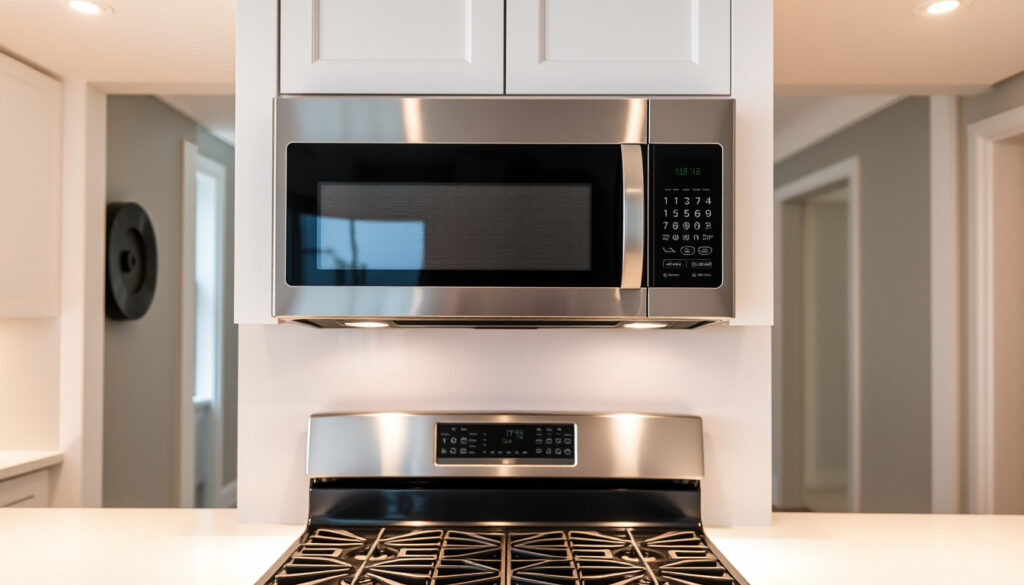
Best Over the Range Microwave: Top Picks Guide
Over-the-range microwaves pack two appliances into one, but the ventilation on most units can’t keep pace with serious stovetop cooking. This guide sorts through the 2026 top picks, price tiers, and the real trade-offs so you can decide whether this two-in-one solution actually fits how you cook.
Top models tested by RTINGS: 5 ·
Models tested by Consumer Reports: 10 ·
Common function: Vent hood ·
Key concern: Cooking frequency ·
Space benefit: Cabinet-mounted
Quick snapshot
- Standard width is 30 inches to fit above standard ranges (US Appliance)
- Budget models start at $200–$350 for 1.6 cu. ft. capacity (US Appliance)
- Consumer Reports lab-tested 10 best over-the-range microwaves in 2026 (Consumer Reports)
- Long-term reliability varies significantly across brands and model years
- Exact noise level (dB) ratings for fan operation rarely disclosed by manufacturers
- Energy efficiency ratings not consistently published for OTR microwaves
- LG MVEM1825F: RTINGS’ best pick with 1000-watt power and quiet operation (RTINGS.com)
- Cafe CVM: 2.1 cu ft with 4-speed 400 CFM ventilation and Wi-Fi (YouTube 7 Best OTR Microwave 2026)
- CFM ratings determine vent power — aim for 300–400 CFM for effective smoke clearance
- Sensor cooking and convection features appear in mid-range ($350–$600) models
- Premium models ($600–$1,000) include air fryer capabilities and smart-home integration
Here are the key specifications that define over-the-range microwaves as a product category.
| Specification | Detail |
|---|---|
| Mounting | Above stove |
| Dual function | Microwave + vent |
| Standard width | 30 inches |
| Top RTINGS pick | LG MVEM1825F (1000 watts) |
| Tested models (RTINGS) | 5 best |
| Tested models (CR) | 10 best |
| Budget range | $200–$350 |
| Common issue | Frequent cooking mismatch |
What is an over-the-range microwave?
An over-the-range microwave mounts directly above your stove, creating a built-in look without requiring a dedicated cabinet cutout. Unlike a countertop model that lives on your counter, these units swing up into the cabinet space above the cooktop.
How it mounts above stove
Installation requires a compatible cabinet above the cooking surface and either a ducted vent connection to the exterior or a charcoal-filter recirculating setup. The standard width is 30 inches, matching the footprint of most residential gas and electric ranges (US Appliance buying guide). A mounting bracket kit typically ships in the box, but professional installation is recommended for wall-mounted or ducted configurations.
Ventilation role
The built-in exhaust fan pulls steam, smoke, and cooking odors upward through filters and either out through ductwork or back into the kitchen via charcoal filters. CFM (cubic feet per minute) measures airflow volume — models range from around 200 CFM in budget units to 400+ CFM in premium designs (The Range Hood Store). The ZLINE 30 in. model, for example, delivers 300 CFM with two-speed ventilation for smoke and grease removal.
The implication: if you do most of your cooking on the stovetop — especially frying or high-heat searing — the vent fan’s CFM rating matters more than the microwave’s wattage.
Are over the range microwaves a good idea?
For kitchens with limited counter space, over-the-range microwaves solve a real problem: they free up the workspace you’d otherwise sacrifice to a bulky countertop appliance. Consumer Reports notes these units remain popular in space-efficient kitchens because they combine two appliances into one (Consumer Reports). The tradeoff is that the vent hood component rarely matches what a dedicated range hood delivers.
Space-saving benefits
By occupying vertical cabinet space rather than horizontal counter space, these units leave your prep area clear for chopping, mixing, and plating. Standard 30-inch models sit flush with most kitchen layouts, creating a built-in appearance without custom cabinetry. Smaller 24-inch options like the COSMO COS-2413ORM1SS (1.34 cu. ft.) serve apartments and compact kitchens where every inch counts.
Limitations for frequent cooks
Over-the-range microwaves aren’t ideal for heavy stovetop cooking. The limited airflow compared to dedicated high-CFM range hoods means smoke and grease can linger longer when you’re frying or simmering at high heat (US Appliance). If you routinely cook multiple burners simultaneously or do a lot of wok-style frying, a separate vent hood with 600+ CFM will outperform any OTR microwave’s fan.
The catch: these units also run louder when the fan and microwave operate together, which some users find disruptive during longer cooking sessions.
OTR microwaves win on space and simplicity. They lose on vent power compared to dedicated hoods priced at similar totals.
What to look for when buying an over-the-range microwave?
CFM rating, cooking power, and installation type form the three decision pillars for most buyers. Beyond those basics, sensor cooking, convection modes, and smart-home connectivity appear in higher price tiers and deserve attention if you value convenience over pure function.
Key features
CFM is the most important spec for the vent function. Look for 300–400 CFM if you regularly cook with significant steam or grease. Sensor cooking automatically adjusts power and time based on moisture levels — a feature that reduces overcooked edges and cold centers. LED cooktop lighting illuminates your range without the heat penalty of older halogen bulbs. Turntable-free convection models use a rotating stirrer for more even heating in mid-range and premium tiers.
- CFM rating: 300 minimum for effective smoke clearance
- Wattage: 900–1000 watts for quick reheating and defrosting
- Capacity: 1.6–2.1 cu. ft. for family-size portions
- Filter type: Charcoal (recirculating) or ducted to exterior
- Smart features: Wi-Fi, Scan to Cook, voice assistant compatibility in premium models
Size and power
Standard width is 30 inches, matching typical kitchen ranges. Interior capacity of 1.6–2.1 cubic feet handles most dinner plates and leftovers without crowding. Wattage between 900 and 1000 watts provides fast, even cooking — the LG MVEM1825F delivers 1000 watts as its headline spec (RTINGS.com). Smaller 24-inch models sacrifice interior volume but fit tighter spaces where a 30-inch unit would overwhelm the cooktop.
What this means: match the interior cubic footage to your household size. Solo cooks or couples save space and money with a 1.4–1.6 cu. ft. model. Families need the 2.0+ cu. ft. capacity for defrosting large cuts or heating multiple portions at once.
What are the best over the range microwaves to buy?
RTINGS and Consumer Reports have both published rankings for 2026, providing lab-tested data on heating performance, noise levels, and vent effectiveness. The top performers balance quiet operation, strong CFM output, and reliable cooking results across wattage settings.
Top RTINGS picks
RTINGS.com named the LG MVEM1825F the best over-the-range microwave tested in 2026, highlighting its 1000-watt power and quiet operation as standouts (RTINGS.com). The publication runs standardized heating tests across evenness, speed, and noise, making their rankings directly comparable. Five models made RTINGS’ “best” category for OTR microwaves, with the LG leading on overall feature set and performance balance.
Consumer Reports leaders
Consumer Reports lab-tested 10 of the best over-the-range microwaves for 2026, evaluating them for quick heating, steam clearance, and user experience (Consumer Reports). Their methodology includes real-food tests and long-term reliability surveys from subscriber data — one of the more robust datasets available outside of manufacturer specs. The full list covers budget, mid-range, and premium tiers with specific model recommendations.
- LG MVEM1825F: RTINGS top pick — 1000 watts, feature-rich, quiet
- Cafe CVM: 2.1 cu. ft. cavity, 4-speed 400 CFM, Wi-Fi and Scan to Cook
- KitchenAid KMHs120ESS: 2.0 cu. ft., 1000 watts, 3-speed 400 CFM
- GE JVM6175SKSS: 400 CFM vent fan, LED lighting
- ZLINE 30 in.: 300 CFM, convection cooking, stainless or black stainless
The pattern: most top-rated models cluster around the mid-range to premium price tiers ($350–$800), with the highest CFM ratings and smart features appearing above $500.
The LG MVEM1825F earned its top spot from RTINGS by balancing what matters most: fast, even heating and a vent fan that doesn’t require shouting to hear the TV.
What are the disadvantages of over the range microwaves?
Every space-saving compromise has a cost. Over-the-range microwaves solve one problem while creating others — particularly for kitchens where cooking happens daily rather than occasionally.
Exhaust vs range hoods
The fundamental limitation is that no over-the-range microwave matches a dedicated range hood’s airflow. Dedicated hoods sit closer to the cooktop, use larger diameter ducting, and often deliver 600+ CFM — more than double the top OTR microwave ratings. If your cooking style leans heavily on the stovetop, a separate hood removes smoke and grease more effectively (US Appliance). The GE JVM6175SKSS offers 400 CFM, which is among the strongest OTR ratings available — still below a mid-tier dedicated hood.
Why people ditch them
Maintenance is a common frustration. Grease filters require regular cleaning, and charcoal filters in recirculating setups need replacement every 6–12 months depending on cooking frequency. The elevated mounting also makes cleaning the interior more inconvenient than a countertop model at eye level. When the vent fan motor fails, you’re replacing two appliances at once — and service calls for built-in units cost more than for countertop models (US Appliance). Some buyers also report that the combined unit creates higher replacement costs down the line: if either the microwave or vent function fails, the entire unit typically needs replacing rather than one component.
The trade-off: accepting OTR limitations makes sense for kitchens where counter space is genuinely scarce and cooking is light to moderate. For serious home cooks, a separate microwave and range hood deliver better individual performance even if they take more counter or cabinet space.
Higher replacement costs compound over time. When the combined unit fails, you buy a new two-in-one — a dedicated hood or countertop microwave can often be repaired or replaced individually.
Three price tiers define the OTR microwave market, and each targets a different buyer profile.
| Price tier | Capacity | Key features | Best for |
|---|---|---|---|
| Budget ($200–$350) | 1.6 cu. ft. | Standard venting, 900–950 watts | Occasional use, apartments |
| Mid-range ($350–$600) | 1.7–2.0 cu. ft. | Sensor cooking, 300–400 CFM, better finishes | Families, regular cooking |
| Premium ($600–$1,000) | 2.0–2.1 cu. ft. | Air fryer, convection, Wi-Fi, 400 CFM | Smart kitchens, heavy use |
Five 2026 models stand out across these tiers based on lab-tested performance and feature depth.
| Model | Capacity | Power | CFM | Notable features | Source |
|---|---|---|---|---|---|
| LG MVEM1825F | 1.8 cu. ft. | 1000W | 300 CFM | Quiet operation, top RTINGS pick | RTINGS.com |
| Cafe CVM | 2.1 cu. ft. | 1000W | 4-speed 400 CFM | Wi-Fi, Scan to Cook, smart features | YouTube 7 Best OTR Microwave 2026 |
| KitchenAid KMHs120ESS | 2.0 cu. ft. | 1000W | 3-speed 400 CFM | Premium build, strong vent | YouTube 7 Best OTR Microwave 2026 |
| GE JVM6175SKSS | 1.8 cu. ft. | 1000W | 400 CFM | Bright LED lighting, high CFM | YouTube Top 5 Best OTR Microwave 2026 |
| ZLINE 30 in. | 1.5 cu. ft. | 1000W | 300 CFM | Convection cooking, black stainless | The Range Hood Store |
Upsides
- Save counter space in tight kitchens
- Dual function: microwave + vent hood in one unit
- Built-in look without custom cabinetry
- Affordable compared to buying separate appliances
- LED lighting illuminates cooktop without heat
- Sensor cooking reduces guesswork in mid-range and up
Downsides
- Weaker ventilation than dedicated range hoods
- Louder when fan and microwave run simultaneously
- Higher replacement cost if either function fails
- Filters require regular maintenance or replacement
- Heavy — requires secure mounting to wall studs
- Interior cleaning more awkward at elevated height
“The best over-the-range microwave we’ve tested is the LG MVEM1825F. This is a fantastic option if you’re looking for a feature-rich, high-end microwave.”
— RTINGS.com (Lab-tested appliance review publication)
“It’s designed to combine microwave and convection cooking into a single solution with a ventilation system.”
— The Range Hood Store (Specialty vent and appliance retailer)
“Not ideal for heavy cooking – limited airflow compared to high-CFM hoods.”
— US Appliance (Appliance buying guide with price-tier analysis)
For buyers in smaller kitchens or apartments, over-the-range microwaves solve a real space crunch without sacrificing the ability to reheat leftovers or defrost proteins. The best picks from RTINGS and Consumer Reports — led by the LG MVEM1825F and comparable KitchenAid and Cafe models — perform well at their core microwave function and deliver usable vent power up to 400 CFM. Heavy stovetop cooks will notice the gap between these integrated units and a dedicated range hood, but for occasional use and moderate cooking, the two-in-one convenience outweighs the performance trade-off.
Related reading: how to cook pork tenderloin · apple pie filling recipe
While premium over-the-range models like the LG MVEM1825F lead in venting power, cheap microwaves under £30 spotlights reliable budget options under £30 for everyday use.
Frequently asked questions
Does over the range microwave have exhaust fan?
Yes. Every over-the-range microwave includes a built-in exhaust fan. CFM ratings typically range from 200 to 400, with models above 300 CFM considered effective for regular kitchen cooking. Some units support ducted venting to the exterior, while others use charcoal filters for recirculating mode.
Over the range microwaves exhaust fans vs range hoods
OTR microwave fans max out around 400 CFM, while dedicated range hoods commonly deliver 600–1,200 CFM. Dedicated hoods sit closer to the cooktop and use larger ducting, which makes them significantly more effective at clearing smoke and grease. If your cooking involves frequent frying or high-heat stovetop work, a separate range hood outperforms any OTR microwave’s ventilation.
What makes a good over the range microwave?
A solid CFM rating (300+), 900–1000 watts of cooking power, sensor cooking automation, and a capacity matching your household size define a good OTR microwave. RTINGS’ top pick, the LG MVEM1825F, earns high marks for combining 1000 watts with quiet operation and a feature set that covers most cooking scenarios without compromise.
Are cheap over the range microwaves reliable?
Budget models ($200–$350) generally offer 1.6 cu. ft. capacity and standard venting in the 200–250 CFM range. They’re reliable for light, occasional use but may underperform for heavy cooking households. Mid-range models ($350–$600) add sensor cooking, stronger fans, and better build quality — the extra cost pays off in durability and cooking results.
Best over the range microwave for small kitchens?
Look for 24-inch models like the COSMO COS-2413ORM1SS (1.34 cu. ft.) that fit tighter spaces above compact cooktops. A smaller interior capacity means less horizontal clearance but still handles standard dinner plates. If your kitchen has a standard 30-inch range, stick with that width for the most interior volume per dollar.
Over the range microwave under cabinet fit?
Over-the-range microwaves mount to the cabinet above the stove, not directly under the upper cabinets in front. Some models offer reduced depth for tighter spaces, but the standard depth (14–18 inches) assumes clearance for door swing and filter access. Measure your cabinet height and cooktop clearance before purchasing — 30 inches of vertical space between cooktop and cabinet bottom is the typical minimum.
Is over the range microwave with light useful?
Built-in cooktop lighting is standard on most OTR microwaves. LED bulbs have largely replaced halogen, reducing heat output while improving brightness. The light serves as a functional range illumination rather than ambient kitchen lighting — useful for evening cooking where you want to see your pan without turning on overhead lights.
More related posts
 How Old Is Gordon Ramsay? Age, Family, Net Worth
 Just Shapes & Beats: Ratings, Platforms, Mobile & Sequel
 Civil War (2024) Film: Controversy, Box Office, and Review
 Days of the Week in Spanish: Pronunciation Guide & Memory Tips
 Knicks vs LA Clippers Match Player Stats – Full Box Scores & Analysis
 All Summer in a Day – Summary Themes Analysis Guide
 Where Is Melania Trump From? Birthplace, Nationality, Life
 University of New Hampshire: Rankings, Acceptance Rate & Guide