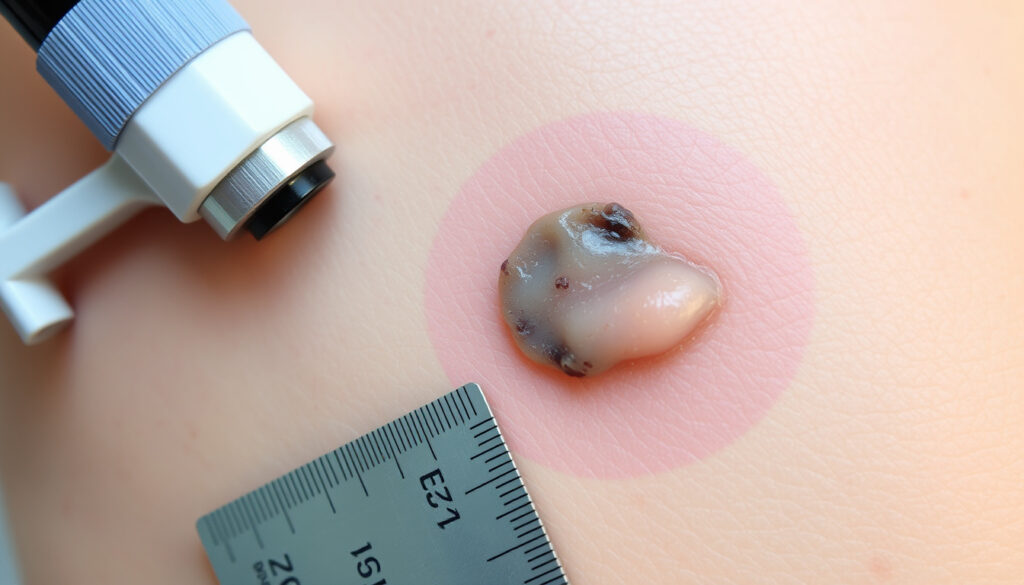
Early Stage Skin Cancer: Visual Signs & Self-Check Guide
You examine a mole in the mirror and pause. Is that outline a little blurry? The spot on your arm that appeared last month—should it still be there? Early stage skin cancer often doesn’t announce itself with pain, but it does leave visual clues. This guide walks through what to look for, how to check yourself, and when a two-week referral could make all the difference.
Most common skin cancer types: basal cell carcinoma, squamous cell carcinoma, melanoma ·
Annual new cases in the US: over 5 million ·
Five-year survival rate for early melanoma: 99% ·
Recommended skin self-exam frequency: monthly ·
Most common site for skin cancers in men: back ·
Most common site for skin cancers in women: legs
Quick snapshot
- ABCDE rule is validated for melanoma detection (American Academy of Dermatology (dermatology professional society))
- Early detection improves survival significantly (PubMed Central (peer-reviewed medical research))
- UV radiation is the primary cause (Cancer Council Australia (national cancer authority))
- Optimal frequency of professional full-body exams for average-risk individuals
- Long-term benefits of smartphone self-check apps vs. clinical exams
- Whether early stage skin cancer reliably causes itching or pain
- 2000s — ABCDE criteria widely adopted for melanoma detection
- 2010 — Ugly duckling sign added as supplementary warning
- 2015 — NHS introduces 2-week wait rule for urgent skin cancer referrals
- 2024 — AI tools improving early detection, research ongoing
- Perform monthly self-exams using the ABCDE rule and ugly duckling sign
- See a GP if you notice a changing mole or non-healing sore
- Urgent referral (2-week rule) if lesion is suspicious for melanoma or high-risk SCC
- Treatment for early stage is usually minor surgery with excellent outcomes
Five key facts, one pattern: early detection is the single most powerful lever for survival. Here’s the data.
| Fact | Value |
|---|---|
| Most common skin cancer type | Basal cell carcinoma (about 80% of cases) |
| Annual US cases of non-melanoma skin cancer | Over 3 million |
| Annual US cases of melanoma | About 100,000 (2024 estimate) |
| Survival rate for localized melanoma (stage 1) | >99% 5-year relative survival |
| Primary cause | Ultraviolet (UV) radiation from sun or tanning beds |
The implication: these numbers confirm that catching skin cancer early changes the outcome dramatically.
What do early skin cancers look like?
Visible changes in moles
- Basal cell carcinoma often appears as a pearly or waxy bump, a pinkish patch, or a sore that heals and returns (American Academy of Dermatology (dermatology professional society)).
- Squamous cell carcinoma may present as a red, scaly patch, a crusted bump, or a dome-shaped growth that bleeds (American Academy of Dermatology).
- Melanoma often shows asymmetry, irregular borders, multiple colors, and a diameter larger than a pencil eraser (Cleveland Clinic (major academic medical center)).
New growths or sores that do not heal
- Any sore that fails to heal within three weeks should be evaluated (DermNet (evidence-based dermatology resource)).
- A spot that bleeds, crusts, or scabs repeatedly is a red flag (Cancer Council Australia (national cancer authority)).
- The skin lesion may be flat or raised, and can feel rough or scaly (American Academy of Dermatology).
The ABCDE rule for melanoma
- Asymmetry: one half unlike the other.
- Border: irregular, scalloped, or poorly defined edges.
- Color: various shades of brown, black, pink, red, white, or blue.
- Diameter: usually >6 mm (about ¼ inch), though melanomas can be smaller (American Academy of Dermatology).
- Evolving: any change in size, shape, color, height, itching, or scabbing (Cleveland Clinic).
Bottom line: Visual clues trump sensation. Most early skin cancers are painless but visible. Check monthly: look for asymmetry, irregular borders, color variation, diameter >6 mm, and any evolving spot.
A mole that looks different from all your other moles—the “ugly duckling”—is often the earliest signal. One study found that the ugly duckling sign can catch melanomas that the ABCDE rule alone might miss (Altitude Dermatology (clinical dermatology practice)).
What are the 7 warning signs of skin cancer?
ABCDE rule plus the ugly duckling sign
- The standard 7 warning signs include the five ABCDE criteria, plus the ugly duckling sign (a spot that looks distinctly different from others), and a sore that does not heal.
- Any new spot that differs from surrounding moles should be checked (American Academy of Dermatology).
- The 5 warning signs (a subset) are the ABCDE criteria alone.
Sores that do not heal
- A wound that persists for more than three weeks without healing is a clinical concern (DermNet (evidence-based dermatology resource)).
- Ulceration, crusting, or bleeding from a lesion should prompt evaluation.
Spread of pigment from a mole
- Pigment that extends beyond the border of a mole into surrounding skin is a potential sign of melanoma (PubMed Central (peer-reviewed medical research)).
- Also watch for redness or swelling beyond the spot.
The implication: these signs are visual and tactile—not purely symptomatic. You don’t need to feel sick to have early skin cancer.
The hardest-to-spot lesions are often on the back (common in men) and legs (common in women). Partner up or use a mirror for those areas (MedlinePlus (U.S. National Library of Medicine)).
Where does skin cancer usually start?
Sun-exposed areas of the body
- Skin cancers most often develop on areas exposed to the sun: face, ears, neck, lips, backs of hands, arms, and scalp (American Academy of Dermatology).
- Basal cell carcinomas heavily favor the face and neck.
Common sites for men and women
- In men, the back is the most frequent location for melanoma (Cancer Council Australia).
- In women, the legs are most affected.
- Non-melanoma skin cancers typically appear on chronically sun-exposed skin; melanoma can also arise on non-sun-exposed sites (American Academy of Dermatology).
Less common locations
- Melanoma can appear on the palms, soles, under nails, and in mucous membranes (MedlinePlus).
- Don’t forget between fingers and toes, and the genital area.
The pattern: UV exposure drives location, but melanoma can be deceptive. Check everywhere—including places the sun doesn’t reach.
What does stage 1 skin cancer feel like?
Sensation in early stage skin cancer
- Stage 1 skin cancer is often painless. Most people notice it visually before they feel anything (Cleveland Clinic).
- Some lesions may be itchy, tender, or bleed when touched (DermNet).
Painless vs. symptomatic lesions
- Basal cell carcinoma may feel like a firm bump, but rarely hurts.
- Squamous cell carcinoma can be tender or crusted.
- Melanoma may cause itching or tingling in some cases (PubMed Central).
The catch: relying on pain as a warning sign is a mistake. By the time it hurts, the cancer may have progressed. Look first, feel second.
What is the 2 week rule for skin cancer?
Who is referred under the 2 week rule
- The 2 week rule is a UK NHS guideline for urgent referral of suspected skin cancer. Patients with suspicious lesions are seen by a specialist within 14 days.
- Candidates: changing mole, non-healing sore, new growth with concerning features.
What to expect during the urgent referral
- You’ll be examined by a dermatologist, often with a dermoscope.
- A biopsy may be performed if the lesion looks suspicious.
- Diagnosis and treatment planning happen quickly.
Why the rule exists
- Melanoma and high-risk squamous cell carcinoma can progress rapidly. Early excision dramatically improves outcomes (PubMed Central).
- The rule reduces wait times for patients who need urgent care.
The trade-off: the 2 week rule is a safety net, not a substitute for routine screening. Speak to your GP if your lesion doesn’t fit the urgent criteria but still worries you.
How to perform a skin self-exam: step by step
These steps follow the protocol recommended by MedlinePlus (U.S. National Library of Medicine) and the American Academy of Dermatology.
- Examine your face, neck, ears, and scalp. Use a mirror for the scalp and ask a partner to help.
- Check your arms and hands. Look at fronts and backs, between fingers, under nails (without polish).
- Use a full-length mirror for your torso. Examine chest, belly, sides, and under breasts.
- Turn around to check your back, buttocks, and the back of your neck. Use a hand mirror.
- Sit down and check your legs, feet, and toes. Look at soles, between toes, and under toenails (MedlinePlus).
- Don’t forget genitals and perianal area. Skin cancer can occur anywhere.
- Document and compare. Take photos of any spot you’re watching. Check monthly for changes.
Why this matters: self-exams can catch early stage skin cancer before it becomes invasive. A monthly check costs nothing and takes 10 minutes.
The 2 week rule is your fastest path to diagnosis if something looks aggressive. For routine monitoring, monthly self-checks using the ABCDE rule and ugly duckling sign are the gold standard. For people with many moles or high sun exposure, an annual professional skin exam adds a layer of security.
Confirmed vs. unclear: what the evidence says
Confirmed facts
- Early detection of skin cancer significantly improves survival rates (Skin Cancer Foundation (non-profit skin cancer organization)).
- ABCDE criteria are validated for melanoma recognition (American Academy of Dermatology).
- Skin cancer is linked to UV exposure (Cancer Council Australia).
- Most skin cancers are curable if treated early (PubMed Central).
What’s unclear
- Optimal frequency of full-body skin exams by a dermatologist for average-risk individuals.
- Long-term benefits of self-check mobile apps compared to clinical exam.
- Early stage skin cancer may or may not cause itching or pain.
Expert perspectives on early detection
“Use the ABCDE rule to look for the signs of melanoma…”
— American Academy of Dermatology (dermatology professional society)
“You should see a GP if you have a skin abnormality that changes shape, size, or color, or does not heal within 4 weeks.”
“When caught early, the five-year survival rate for melanoma is 99 percent.”
— Skin Cancer Foundation (non-profit skin cancer organization)
Summary
The best weapon against early stage skin cancer is your own eyes—checking monthly, knowing the ABCDE rule, and acting fast when something looks off. For the average person in the U.S., the choice is clear: a 10-minute self-exam every month, plus an annual professional check if you have risk factors like fair skin, many moles, or a history of sunburns. Waiting until a spot hurts or bleeds can cost you that 99% survival window.
For further reading on related health topics: Swollen Lymph Nodes Neck: Red Flags and When to Worry and What Is an MRI? How It Works, What It Shows, and What to Expect.
treatcancer.com, healthywithpardee.com, alaskadermatologist.com, adaderm.com, mattioli1885journals.com
Many people first notice changes by applying the ABCDE rule to their moles, and understanding early stage skin cancer signs makes this process even more reliable.
Frequently asked questions
Can skin cancer appear on skin not exposed to the sun?
Yes. Melanoma can develop on areas that rarely see sunlight, including the palms, soles, under nails, and mucous membranes. While UV exposure is the primary risk factor, genetics also play a role (American Academy of Dermatology).
How often should I check my skin for signs of cancer?
Most experts recommend a monthly self-exam. If you have many moles, a history of sunburns, or a family history of skin cancer, consider an annual professional skin check (MedlinePlus).
What does a non-melanoma skin cancer spot look like?
Basal cell carcinoma may appear as a pearly bump, a pinkish patch, or a sore that heals and returns. Squamous cell carcinoma often looks like a red, scaly patch, a crusted bump, or a firm nodule (American Academy of Dermatology).
Is early stage skin cancer itchy?
Some lesions can be itchy or tingling, but many are completely asymptomatic. Itching alone is not a reliable indicator—visual changes are more dependable (DermNet).
Can a mole that has been there for years become cancerous?
Yes. While many melanomas arise as new spots, about 20–30% develop from existing moles. That’s why the “E” (evolving) in the ABCDE rule is important—any change warrants attention (PubMed Central).
What should I do if I find a suspicious spot?
Don’t wait. See your GP or a dermatologist for evaluation. If the lesion is changing rapidly or has multiple ABCDE features, ask about the 2 week rule referral pathway. A biopsy may be needed (NHS).
Are skin cancers always raised?
No. Early stage skin cancers can be flat, especially melanoma in situ. Basal and squamous cell carcinomas can be flat or raised. Thickness often correlates with progression (American Academy of Dermatology).
How is early stage skin cancer diagnosed?
Diagnosis starts with a visual and dermoscopic exam by a dermatologist. If the lesion is suspicious, a biopsy is taken and examined under a microscope. Imaging is rarely needed for early stage (MedlinePlus).
More related posts
 How Old Is Ice Spice? Real Name & Birthday
 Where Is Area 51 – Exact Coordinates, Maps and Restrictions
 Precio del Dólar Hoy en Elektra: Rate Comparison
 What Is an NFT? Definition, How It Works & Value in 2025
 What Is an Idiom? Definition, Examples & Simple Explanations
 Disney Plus Hulu Bundle – Pricing Plans and Savings
 Cake Shop Near Me: Prices, Freshness Rules, and Best Bakery Picks
 Marine Veteran Wife Detained While Breastfeeding: What Happened?