What Does a Tick Bite Look Like? Signs, Symptoms, and When to Worry
A tick bite often goes unnoticed until a rash appears days later. Knowing exactly what to look for—from the initial red bump to the expanding bullseye of Lyme disease—can determine whether you catch an infection early or let it spread.
Number of tick-borne diseases in the U.S.: at least 16 (CDC) · Percentage of Lyme disease cases with erythema migrans rash: 70–80% (CDC) · Time from tick bite to rash onset: 3 to 30 days (CDC) · Estimated risk of Lyme disease after a deer tick bite in endemic area: 1–3% (CDC)
Quick snapshot
- Exact risk of Lyme disease after a single bite varies by region and tick species (CDC)
- Not all tick bites cause rashes (Johns Hopkins Medicine)
- The rash may not always be a classic bullseye (Harvard Lyme Disease Initiative)
- Day 0: Tick attaches (CDC)
- Day 3–30: Rash may appear (CDC)
- Week 2–4: Flu-like symptoms may develop (Mayo Clinic)
- See a doctor if rash or fever develops (CDC)
- Remove tick within 24 hours to reduce Lyme risk (CDC)
- Monitor bite site for changes over several weeks (American Academy of Dermatology)
Several key facts can help you quickly assess a tick bite. The appearance and timing of the rash are the strongest clues.
| Fact | Detail | Source |
|---|---|---|
| Tick size (deer tick nymph) | About the size of a poppy seed | CDC |
| Typical bite site | Armpits, groin, scalp, behind knees | CDC |
| Time to remove tick to reduce risk | Within 24 hours | CDC |
| Rash onset after bite | 3–30 days (average 7 days) | CDC |
| Rash can expand up to | 12 inches (30 cm) across | Johns Hopkins Medicine |
| Early Lyme symptoms (no rash possible) | Fever, chills, headache, fatigue, muscle aches, swollen lymph nodes | Mayo Clinic |
| Percentage of Lyme patients with EM rash | 70–80% | CDC |
How do you tell if a bite is from a tick?
What does a tick bite look like without the tick?
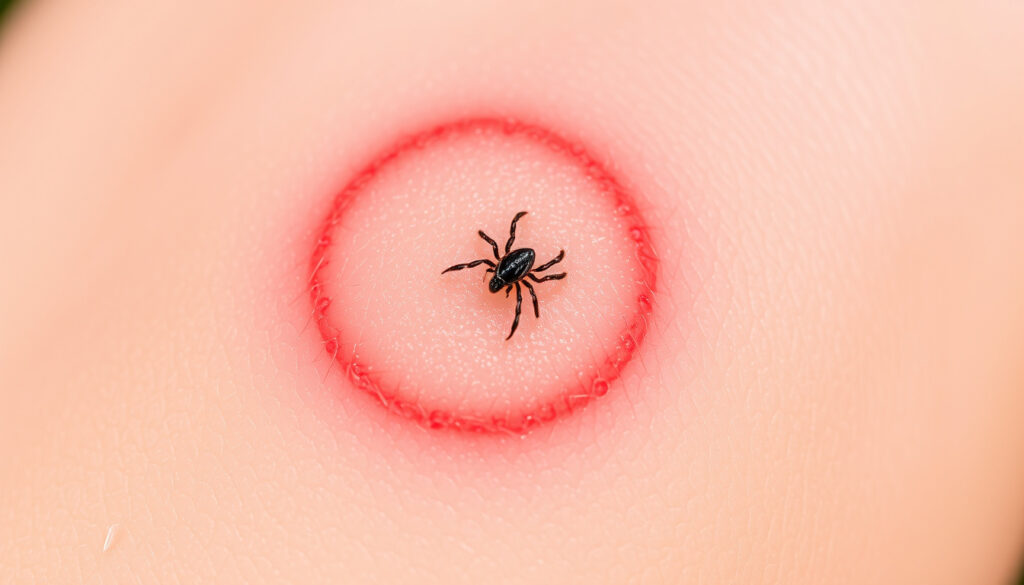
- A tick bite often appears as a small red bump, sometimes with a dark dot at the center (the tick’s mouthparts) if the tick was attached (CDC).
- Unlike mosquito bites, tick bites are usually painless initially and may not itch (Mayo Clinic).
- The presence of a tick or a black dot (the mouthparts) is a key identifier (CDC).
The implication: if you see a pinpoint red mark that doesn’t itch or hurt, and you’ve been outdoors, consider it a potential tick bite and watch for changes.
How does a tick bite differ from a mosquito bite?
Comparing bite characteristics reveals clear distinctions that help with identification.
| Feature | Tick bite | Mosquito bite | Spider bite |
|---|---|---|---|
| Initial sensation | Often painless or a mild sting | Sharp sting followed by itch | Sharp pain, sometimes burning |
| Appearance | Small red bump; may have dark center if tick remains | Raised, puffy white/red welt | Two puncture marks; redness around |
| Itching | Rarely itches initially | Almost always itches intensely | Can itch or sting |
| Rash progression | Can expand into bullseye over days | Resolves in a few days | May blister or form necrotic area |
The pattern: if a bite doesn’t itch and expands over several days, tick involvement is much more likely.
What does a tick look like?
- Deer ticks (black-legged ticks) are small: nymphs are about the size of a poppy seed, adults about a sesame seed (CDC).
- They have eight legs (adults) and a flat, oval body that swells after feeding (CDC).
- Color ranges from reddish-brown to dark brown (CDC).
What are the first symptoms after a tick bite?
What are at least 5 early signs of Lyme disease?
- Fever, chills, headache, fatigue, and muscle/joint aches (CDC).
- Swollen lymph nodes near the bite site (Mayo Clinic).
- The erythema migrans rash—expanding red patch with central clearing—is the hallmark (CDC).
- Not all tick bites cause symptoms; many are harmless (Johns Hopkins Medicine).
- Symptoms can appear 3 to 30 days after the bite (NHS).
What are bad signs after a tick bite?
- A rapidly expanding rash—especially one that grows larger than 5 cm (CDC).
- Fever, severe headache, stiff neck, or facial paralysis (Bell’s palsy) suggest disseminated Lyme (Mayo Clinic).
- If the bite site becomes increasingly red, warm, or oozes pus, it may be infected (American Academy of Dermatology).
The catch: early Lyme symptoms mimic flu—many people dismiss them. But when paired with a known tick bite, they demand medical attention.
What does an untreated tick bite look like?
What does a tick bite look like after a week?
- After a week, a tick bite from a Lyme-infected tick may show an expanding red rash, sometimes with central clearing (bullseye) (CDC).
- The rash can grow to 12 inches across, and may be warm to the touch but not painful (Johns Hopkins Medicine).
- Without treatment, the rash may persist for weeks, and systemic symptoms like fatigue, fever, and joint pain may develop (CDC).
A rash that continues to expand after a week is the strongest visual clue of early Lyme disease. Almost 80% of cases present this way, according to CDC data.
What are the odds of getting Lyme disease from a tick?
- In areas where Lyme is endemic, the risk of infection after a deer tick bite is about 1–3% (CDC).
- The risk increases the longer the tick stays attached—after 24 hours, risk rises significantly (CDC).
- Not all tick species carry Lyme; the black-legged tick (Ixodes scapularis) is the main vector in the eastern U.S. (CDC).
The trade-off: even a low infection rate translates to thousands of cases annually. Prompt tick removal reduces your odds dramatically.
When to worry about a tick bite?
Are tick bites dangerous?
Most tick bites are harmless, but ticks can transmit several diseases besides Lyme, including Rocky Mountain spotted fever, anaplasmosis, and babesiosis (CDC).
- Seek medical attention if you develop a rash, fever, flu-like symptoms, or if the bite area becomes infected (CDC).
- A bullseye rash is a strong indicator of Lyme disease and requires treatment (Mayo Clinic).
- If you cannot remove the tick completely or symptoms worsen, see a doctor (CDC).
The pattern: the window for early treatment is widest in the first 30 days after a bite. After that, the infection can become disseminated and harder to treat.
What are bad signs after a tick bite? (covered above)
Repeated here for emphasis: the combination of expanding rash and systemic symptoms is a red flag. Also, look for signs of local infection: increasing redness, warmth, pus, or red streaks.
“Rash that appears within 30 days of a tick bite and expands to more than 5 cm is the hallmark of early Lyme disease.”
— CDC, Signs and Symptoms of Untreated Lyme Disease
What does a tick bite look like after a week?
What does an untreated tick bite look like? (covered above)
What does a tick bite look like on a dog?
- On dogs, tick bites may cause localized hair loss, a small red lump, or scabbing (CDC).
- The tick may remain attached for days, swelling as it feeds; it’s often found around the ears, neck, and between toes (CDC).
- After removal, the bite site may remain raised and red for a few weeks (American Academy of Dermatology).
The implication: tick bites on pets require the same vigilance as on humans—if you see a lump or scab, inspect closely for an attached tick.
What to do if a tick bites you?
- Use fine-tipped tweezers to grasp the tick as close to the skin as possible and pull upward with steady, even pressure (CDC).
- Clean the bite area and your hands with rubbing alcohol or soap and water (CDC).
- Save the tick in a sealed bag or jar for potential identification (CDC).
- Monitor the bite site for the next 30 days for any rash or symptoms (CDC).
- Contact your doctor if you develop a rash, fever, or flu-like symptoms (Mayo Clinic).
The catch: quick removal within 24 hours is your best protection—the longer a tick feeds, the greater the chance of disease transmission.
Tick Bite Timeline: From Bite to Symptoms
- – Tick attaches to skin.
- – Bite may appear as a small red bump (CDC).
- – Erythema migrans rash may appear if infected (NHS).
- – Flu-like symptoms may develop (Mayo Clinic).
- – If untreated, Lyme disease can cause arthritis, neurological issues (CDC).
The pattern: the window for early treatment is widest in the first 30 days after a bite. After that, the infection can become disseminated and harder to treat.
Confirmed Facts and Unclear Aspects
Confirmed facts
- Tick bites can cause Lyme disease (CDC).
- Erythema migrans is a hallmark of Lyme disease (Mayo Clinic).
- The rash expands over days and can reach 12 inches (Johns Hopkins Medicine).
- Early Lyme symptoms include fever, chills, headache, fatigue (CDC).
- Prompt tick removal reduces disease risk (CDC).
What’s unclear
- Exact risk of Lyme disease after a single bite varies by region and tick species (CDC).
- Not all tick bites cause rashes (Johns Hopkins Medicine).
- The classic bullseye pattern may not appear in many cases (Harvard Lyme Disease Initiative).
- Co-infections from the same tick can complicate diagnosis (CDC).
“Early symptoms of Lyme disease can be mistaken for a virus. But when a rash follows a tick bite, it’s a strong signal to get tested.”
For anyone who spends time outdoors in tick-prone areas, the choice is clear: inspect your skin daily and remove ticks promptly, or risk a multi-week course of antibiotics and possible long-term joint and neurological symptoms. Early detection is your best defense.
Related reading: Early Stage Skin Cancer: Visual Signs & Self-Check Guide — how to identify unusual skin changes; Swollen Lymph Nodes Neck: Red Flags and When to Worry — swollen nodes are a common sign of Lyme disease.
gov.uk, my.clevelandclinic.org, pmc.ncbi.nlm.nih.gov, en.wikipedia.org, fda.gov, globallymealliance.org
Frequently asked questions
Can a tick bite cause a rash without Lyme disease?
Yes. The bite itself can cause a local allergic reaction or a small red bump that is not erythema migrans. Other tick-borne diseases cause different rashes, such as Rocky Mountain spotted fever (spotted rash) (CDC).
How long does a tick bite last?
The bite mark from an uninfected tick usually fades within a few days to a week. An expanding Lyme rash can last for weeks without treatment (CDC).
Should I save the tick for testing?
Yes. Place the tick in a sealed bag or vial with a damp cotton ball and label the date. Your doctor or local health department may want to identify the species and test for pathogens (CDC).
Can I get Lyme disease from a tick that wasn’t attached long?
Risk is very low if the tick is removed within 24 hours. Transmission of Borrelia burgdorferi typically requires 36–48 hours of attachment (CDC).
What should I do if I find a tick crawling on me?
Remove it with tweezers and dispose of it. You don’t need to worry if it hasn’t bitten—but check your entire body for attached ticks (CDC).
Do all tick bites leave a red mark?
No. Some bites leave almost no visible mark, especially if the tick is removed quickly. The absence of a mark doesn’t rule out a bite (Johns Hopkins Medicine).
Is it normal for a tick bite to swell?
Mild swelling is common. But if the swelling increases after a few days, becomes warm, or is accompanied by redness spreading outward, see a doctor—it could be an infection or early Lyme (American Academy of Dermatology).
More related posts
 Big 12 Championship Game 2025: Odds, Teams & History
 Demon Slayer: Kimetsu no Yaiba Watch Order & Season 5 Update
 Epcot Food and Wine Festival 2025 – Dates Tickets Booths Concerts
 New York ZIP Codes: Manhattan, Brooklyn, Queens & More
 Mood Ring Color Meanings: Complete Guide to Colors and Emotions
 Check Your Dairy Queen Gift Card Balance
 Miracle on 34th Street 1947 Cast: Full Guide & Where They Are
 Days of the Week in Spanish: Pronunciation Guide & Memory Tips