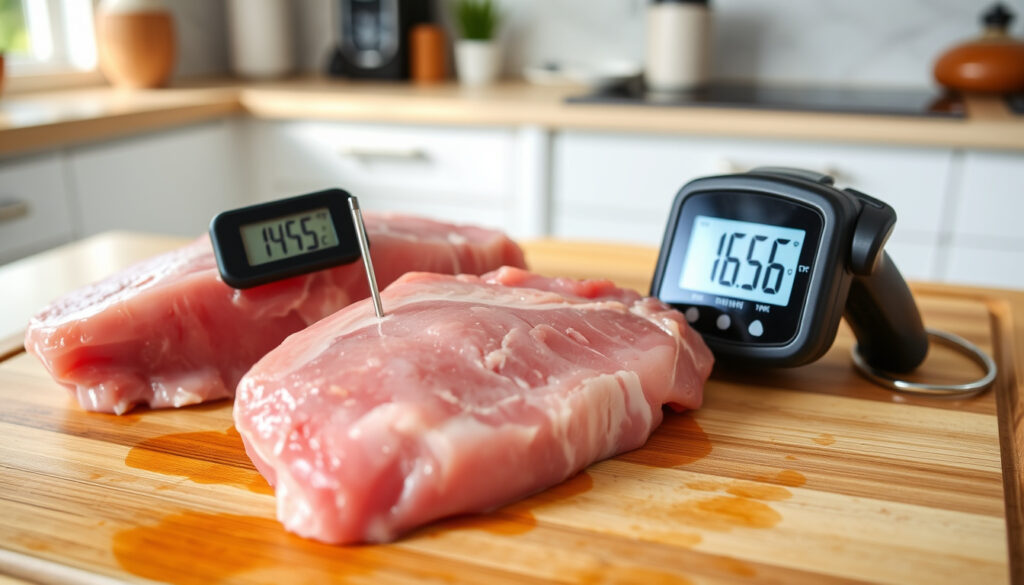
Pork Chop Internal Temp: 145°F vs 165°F – Safe Cooking Guide
Anyone who’s ever pulled a dry, chalky pork chop off the grill knows the pain, but it’s almost always a fixable temperature problem. The USDA now recommends cooking pork chops to 145°F (63°C) followed by a 3-minute rest — a change that happened back in 2011 but still catches many home cooks off guard.
USDA safe minimum internal temperature: 145°F (63°C) ·
Recommended rest time: 3 minutes ·
Temperature for well-done pork chops: 160°F (71°C) ·
National Pork Board endorsed final temp: 145°F – 160°F ·
Carryover cooking temperature rise: 5–10°F
Quick snapshot
- Whole pork chops are safe at 145°F with a 3-minute rest (USDA)
- Cooking above 160°F dries out the meat (National Pork Board)
- The 6-2-2 rule is not standard for pork chops
- Exact cooking times vary widely by thickness and heat source
- USDA lowered pork whole-cut temp from 160°F to 145°F in 2011 (USDA)
- Cook to 145°F, rest 3 min, then slice
- Use an instant-read thermometer for accuracy
Five key temperature benchmarks, one pattern: the sweet spot for juicy pork chops is narrower than most people think.
| Label | Value |
|---|---|
| USDA safe minimum internal temperature | 145°F (63°C) |
| Rest time after cooking | 3 minutes |
| Well-done temperature | 160°F (71°C) |
| Carryover cooking rise | 5–10°F |
| National Pork Board recommended range | 145°F – 160°F |
Should pork chops be 145 or 165?
USDA recommendation for pork chops
- The USDA (U.S. Department of Agriculture) states whole cuts of pork, including pork chops, are safe at 145°F with a 3-minute rest.
- The 2011 change from 160°F to 145°F was based on updated food-science data — CIDRAP News reported the announcement on May 24, 2011.
Why 145°F with a rest is safe
- The USDA says a 3-minute rest at 145°F is just as safe as the previous 160°F recommendation for whole cuts (USDA).
- The National Pork Board (industry authority) endorses 145°F for fresh cuts like pork chops, pork loin, and tenderloin.
The myth of 165°F for pork
- 165°F is the safe temperature for ground meats and poultry, not whole cuts of pork (CIDRAP News).
- Cooking pork chops to 165°F guarantees safety but almost always produces dry, tough meat — the tissue tightens and moisture is pushed out (ThermoWorks (specialist thermometer manufacturer)).
The 20°F gap between 145°F and 165°F is the difference between a chop that weeps moisture and one that holds it. For a 1-inch chop, that’s about 2 extra minutes on the heat — and it makes all the difference.
The implication: targeting a mid-range temp around 150°F and letting carryover nudge it to 145°F is the sweet spot. But official guidelines are clear — 145°F after rest is the floor.
What temperature is a pork chop done UK?
Celsius equivalent for pork doneness
- 145°F equals 63°C — that’s the target for pork chops in Celsius (FoodDocs (food safety platform)).
- Health Canada (federal food safety agency) lists 63°C for pork cuts including loin, ribs, and ham.
UK cooking guidelines vs US
- The UK’s Food Standards Agency recommends 70°C for all pork, which equals 158°F — slightly higher than the US 145°F (Health Canada notes that their own guidance for pieces and whole cuts is 71°C).
- US guidance is 63°C (145°F) for whole cuts; the difference is due to historical risk perception. Both are safe when followed with proper rest.
Using a meat thermometer in Celsius
- An instant-read thermometer set to Celsius should read 63°C when inserted into the thickest part of the chop.
- ThermoWorks advises pulling the chop at 60–61°C to account for carryover cooking that will bring it to 63°C during the rest.
What is the 6 2 2 rule for pork?
Understanding the 6-2-2 method
- The 6-2-2 rule is a popular method for smoking pork shoulder: 6 hours unwrapped, 2 hours wrapped, 2 hours resting in a cooler.
- It does not apply to pork chops, which are lean and cook quickly.
Does it apply to pork chops?
- No. Pork chops lack the fat and connective tissue that benefit from long, slow cooking. Applying the 6-2-2 method would result in dry, overcooked meat.
Alternative techniques
- For pork chops, use direct heat methods: pan-sear at medium-high for 3–4 minutes per side (thin chops) or 6–8 minutes per side (thick chops).
- Always rely on internal temperature, not time alone.
Is 20 minutes long enough to cook pork chops?
Factors affecting cooking time
- Cooking time depends primarily on thickness: a ½-inch thin chop can be done in 8–10 minutes total, while a 1½-inch thick chop may need 20–25 minutes.
- Heat level matters: pan-searing at 400°F cooks faster than oven-baking at 350°F.
Thickness and heat level
- For a 1-inch boneless pork chop cooked at medium-high heat (375°F–400°F), 20 minutes is typically enough to reach 145°F.
- Bone-in chops take slightly longer due to heat conduction around the bone — add 2–3 minutes per side.
Using internal temp to determine doneness
- Time is a rough guide; the only definitive check is an instant-read thermometer.
- ThermoWorks recommends inserting the probe sideways into the thickest part, avoiding bone or fat.
Is pork chop safe to eat at 135?
Risks of undercooking pork
- Pork cooked to 135°F is below the USDA safe minimum of 145°F. While the risk of trichinosis is extremely low in modern pork (USDA), it is not zero.
What happens at 135°F
- At 135°F, any potential pathogens are not reliably killed. The 3-minute rest at 145°F is what provides the safety margin.
- Eating pork at 135°F is a personal risk decision; official guidance says no.
Minimum safe temperature
- The USDA insists on 145°F with a rest for whole cuts, and 160°F for ground pork (ThermoWorks).
- FoodDocs confirms 63°C as the minimum for whole cuts.
Three temperature targets, one clear recommendation: 145°F for whole chops, 160°F for ground, 165°F for poultry. Pork chops live in the first group.
| Criterion | 145°F (63°C) with rest | 165°F (74°C) |
|---|---|---|
| Safety for whole pork chops | Safe (USDA) | Safe but overkill |
| Juiciness | High — retains moisture | Low — moisture squeezed out |
| Typical texture | Tender, pinkish center | Dry, gray throughout |
| Recommended by | USDA, National Pork Board, Health Canada | None for whole pork (only for ground/poultry) |
| Carryover after rest | Rises to ~150°F | Rises to ~170°F, further drying |
The trade-off: 165°F guarantees safety but guarantees dryness. 145°F with rest is both safe and succulent — the only reason to choose 165°F is if you’re cooking ground pork or poultry.
Seven cuts, one pattern: whole muscle pork needs 145°F; ground and processed pork need higher temps.
| Cut | Internal temperature | Rest time |
|---|---|---|
| Pork chop (bone-in or boneless) | 145°F (63°C) | 3 minutes |
| Pork loin roast | 145°F (63°C) | 3 minutes |
| Pork tenderloin | 145°F (63°C) | 3 minutes |
| Ground pork | 160°F (71°C) | None needed |
| Pork sausages | 160°F (71°C) | None needed |
| Pork shoulder (pulled) | 200–205°F (93–96°C) | 30 minutes |
| Pre-cooked ham (to reheat) | 140°F (60°C) | None needed |
The pattern: lean, whole cuts perform best at 145°F with rest. Ground and tough cuts require higher temperatures for safety or tenderness.
How to cook pork chops to perfect doneness
- Step 1: Choose your chop
- Thickness: 1 to 1½ inches for even cooking. Bone-in adds flavor but takes slightly longer.
- Brining optional but recommended: soak in saltwater for 30–60 minutes to enhance juiciness.
- Step 2: Season and preheat
- Pat dry, season with salt and pepper. Preheat pan or grill to medium-high (375°F–400°F).
- For oven roasting, heat to 400°F.
- Step 3: Cook to about 140°F
- Pan-sear: 3–4 min per side for thin chops, 6–8 min per side for thick. Use a thermometer to check.
- Oven: bake 12–18 min depending on thickness.
- Sous-vide: 140°F for 1–2 hours, then sear 1 min per side.
- Step 4: Rest for 3 minutes
- Remove from heat when internal temp hits about 140°F (carryover will bring it to 145°F).
- Rest on a cutting board or plate, uncovered, for exactly 3 minutes — do not skip.
- Step 5: Check final temp and serve
- After rest, insert thermometer into thickest part. It should read 145°F. If not, return to pan for 1 minute and rest again.
- Slice against the grain, serve immediately.
The 3-minute rest is not optional — it’s when the meat’s enzymes kill lingering bacteria and the juices redistribute. Skipping it undoes the safety and flavor benefits of the lower cooking temp.
What we know vs what’s unclear
Confirmed facts
- Pork chops are safe at 145°F with a 3-minute rest (USDA, National Pork Board, Health Canada).
- Cooking above 160°F results in dry meat (ThermoWorks).
- The 2011 USDA change applies only to whole cuts, not ground pork or poultry (CIDRAP).
What’s unclear
- Exact cooking times vary widely by thickness, bone presence, and heat source — there’s no universal minute-per-side rule.
- The 6-2-2 rule is not standard for pork chops and may confuse home cooks.
- Whether UK’s 70°C guideline provides any meaningful safety advantage over 63°C for whole cuts is debated.
“The safe internal pork cooking temperature for fresh cuts is 145°F followed by a 3-minute rest.”
— National Pork Board (industry authority)
“The result of cooking pork to 145°F with a 3-minute rest is a product that is safe, juicy, and tender.”
— USDA (U.S. Department of Agriculture)
“Pork is generally safe to eat when cooked to a minimum internal temperature of 63°C.”
— FoodDocs (food safety platform)
“The revised temperature recommendation only applies to pork whole-muscle cuts such as tenderloin, chops, and roasts.”
— ThermoWorks (specialist thermometer manufacturer)
For home cooks who want the juiciest pork chop possible, the choice is clear: target 145°F with a 3-minute rest, not 165°F. That 20°F difference transforms a dry, gray slab into a tender, pink-centered cut that’s both safe and satisfying. Armed with a thermometer and this guide, you’ll never settle for overcooked pork again.
bbq-brethren.com, facebook.com, thenoshery.com, instagram.com, reddit.com, facebook.com
For those who prefer baking, our oven-baked pork chop guide offers detailed timing and temperature tips to achieve the same juicy results.
Frequently asked questions
Can pork chops be pink at 145°F?
Yes. The USDA confirms that pork at 145°F can still have a pink hue — that’s normal and safe. Color alone is not a reliable doneness indicator.
Do I need to brine pork chops?
Brining helps lock in moisture, especially for lean cuts. A 30-minute saltwater soak improves juiciness, but it’s optional if you cook to 145°F and rest properly.
What’s the difference between bone-in and boneless internal temp?
Both should reach 145°F. Bone-in chops take slightly longer because the bone conducts heat unevenly. Always test near the center, away from bone.
How do I check internal temp without a thermometer?
It’s not recommended. Visual cues like firmness and juice color are unreliable. An instant-read thermometer is the only way to guarantee safety and doneness.
Should I let pork chops rest after cooking?
Yes — a 3-minute rest is mandatory for safety and juiciness. It allows carryover cooking to finish the process and redistributes juices.
What is carryover cooking for pork chops?
Carryover cooking is the temperature rise that occurs after removing meat from heat. For pork chops, internal temp can climb 5–10°F during rest. Pull the chop at around 140°F to land at 145°F.
More related posts
 Freevee Streaming Service Closure Amazon: What You Need to Know
 Sur La Table Cooking Classes: Ireland Reviews & Locations
 San Antonio Spurs vs New Orleans Pelicans Match Player Stats – Box Score & Recap
 MSF Course Near Me: Cost, Gear & Licence Steps in Ireland
 2/3 Cup – Tbsp, Grams, Oz Conversions
 Just Shapes & Beats: Ratings, Platforms, Mobile & Sequel
 Jem and the Holograms: LGBTQ Themes, Cancellation, and Facts