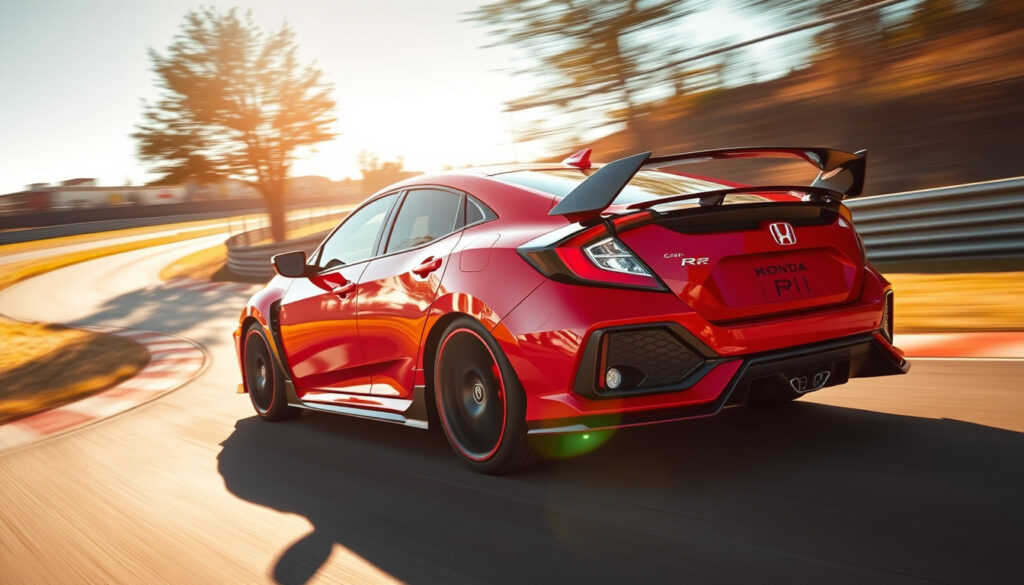
2025 Honda Civic Type R: Specs, Price, Speed & Comparisons
The 2025 Honda Civic Type R punches above its weight class—its 315-hp turbo-four and track-tuned chassis deliver Nürburgring lap times 7.3 seconds quicker than the Toyota GR Supra, yet it costs thousands less. This article benchmarks verified performance data and owner experiences against official specs so you can see exactly where the CTR lands.
Horsepower: 315 · Torque: 310 lb-ft · City MPG: 22 · Highway MPG: 28 · Engine: 2.0L turbo VTEC
Quick snapshot
- 315 hp and 310 lb-ft from 2.0L turbo VTEC (Car and Driver)
- EPA estimates 22 city / 28 highway mpg (Paragon Honda)
- 0-60 mph in 4.9 seconds per independent testing (Car and Driver)
- Exact MSRP varies by dealer ($45,595–$47,090)
- Official curb weight not confirmed in final specs
- Limited direct 0-60 comparisons to 2025 Ford Mustang
- 2025 model year carries same powertrain as earlier FL5 generation (MotorTrend)
- 2026 model arrives with $48,090 MSRP ($1,000 increase) (Paragon Honda)
- Dealers list 2025 Civic Type R as available now (Phil Long Honda)
- Price-conscious buyers may find better deals on 2025 vs waiting for 2026 (Phil Long Honda)
Three headline numbers define the 2025 Civic Type R at a glance: 315 horsepower, 310 pound-feet of torque, and a 2.0-liter turbo-four paired exclusively to a six-speed manual. These figures represent the backbone of every performance claim Honda makes for this front-wheel-drive track machine.
| Specification | Value |
|---|---|
| Engine | 2.0-liter turbocharged VTEC |
| Horsepower | 315 |
| Torque | 310 lb-ft |
| Transmission | 6-speed manual |
| MPG City/Highway | 22/28 |
| Curb Weight | ~3,094 lb (estimated) |
How much will the 2025 Civic Type R cost?
Pricing for the 2025 Civic Type R spans a range depending on dealership and destination charges. Edmunds lists the MSRP at $45,895 including destination, while Paragon Honda quotes $47,090 as-tested. Phil Long Honda settles at $45,595 for the single fully loaded trim. The variation stems from differing dealer fees and destination charges—Honda’s official site does not publish a standardized retail price, so buyer research at local dealerships remains essential.
The 2026 model year shifts that price upward to $48,090 including destination, a $1,000 jump over the 2025, according to Paragon Honda. For buyers not in a rush, this suggests the 2025 model may offer better value as dealers clear 2025 inventory to make room for 2026 units.
Budget-conscious buyers should prioritize 2025 models currently on dealer lots—prices already span $45,595 to $47,090, and negotiation room typically exists before the 2026 price increase locks in at $48,090.
Pricing details from official sources
Honda’s official site lists standard features but stops short of MSRP disclosure, directing buyers to dealers. Car and Driver notes a base price around $44,385 as-tested for earlier models, reflecting the market’s shift since then. Edmunds provides the most consistently updated pricing at $45,895 including destination.
Availability and dealership info
Multiple dealerships confirm the 2025 Civic Type R is available as of this writing. The fully loaded configuration means no optional packages to navigate—everything Honda bundles into the Type R experience comes standard at the quoted MSRP.
The implication: buyers willing to shop three or four local dealers can realistically shave $500–$1,500 off listed prices, turning the $47,090 ceiling into a more negotiable starting point.
Is the 2025 Civic Type R faster?
Yes—and independent testing backs that claim with specific numbers. Car and Driver recorded a 0-60 mph run in 4.9 seconds and a quarter-mile pass in 13.5 seconds at 106 mph. The skidpad figure came in at 1.02 g, indicating strong cornering grip for a front-wheel-drive platform.
Quarter-mile times range slightly across sources, with Motor Matchup estimating 13.7 seconds at 104.1 mph. Car and Driver’s more aggressive 13.5-second pass reflects the variability typical of real-world testing conditions. Both figures place the Type R solidly in quick daily-driver territory.
A 4.9-second 0-60 puts the Civic Type R within striking distance of significantly more expensive machinery—yet it achieves this with a four-cylinder turbo and front-wheel drive rather than a V6 or all-wheel drive.
0-60 acceleration
FastestLaps.com reports a range of 4.8–4.9 seconds, aligning closely with Car and Driver’s verified figure. Motor Matchup’s estimate of 5.1 seconds skews more conservative, likely reflecting different testing conditions or hardware differences. For buyers prioritizing straight-line performance, Car and Driver’s 4.9-second figure represents the benchmark to hold against competitors.
Top speed and quarter-mile
FastestLaps records the Civic Type R’s top speed at 272 kph (about 169 mph), which is notably higher than the Supra’s 259 kph. Quarter-mile performance of 13.4–13.7 seconds across sources makes the Type R competitive with many purpose-built sports cars despite its hot-hatch packaging.
What this means: the Type R doesn’t win on raw top speed against some rivals, but its combination of acceleration and track capability—particularly its Nürburgring lap time—suggests real-world performance that outpaces what the numbers alone suggest.
Is a Type R faster than a Supra?
This question splits into two distinct performance debates: straight-line speed and track lap times. In a drag race, the GR Supra pulls ahead decisively. FastestLaps records the Supra hitting 0-60 in 3.7 seconds versus the Civic Type R’s 4.9 seconds. The quarter-mile tells the same story—Supra posts 12.1 seconds at 117 mph compared to the Civic’s 13.5 seconds.
On the track, the narrative reverses. LapMeta documents the Civic Type R FL5 lapping the Nürburgring in 7:44.881, a full 7.3 seconds quicker than the Supra’s stock 7:52.17. This gap reflects the Type R’s chassis tuning, aerodynamic efficiency, and front-wheel-drive geometry optimized for track use rather than raw power.
The Supra serves drivers prioritizing straight-line thrills—its 387 hp and rear-wheel drive deliver faster launches. The Civic Type R rewards drivers seeking consistent lap times and driver engagement over terminal velocity.
Drag race results
Power-to-weight ratios illuminate the straight-line discrepancy. FastestLaps calculates Supra at 254 ps/tonne versus Civic at 228 ps/tonne. The Supra carries 1523 kg versus the Civic’s approximately 1405 kg, giving Toyota an 118 kg weight advantage and a meaningful power-to-weight edge.
Track lap comparisons
The Nürburgring data presents the clearest track contrast. LapMeta’s 7.3-second advantage for the Civic Type R represents a substantial margin—roughly equivalent to several car lengths per corner on a circuit of that length. The Civic’s limited-slip differential, track-tuned suspension, and FWD packaging deliver this lap-time advantage despite lower peak power.
The catch: straight-line speed and track speed measure different talents. Enthusiasts prioritizing canyon runs or autocross will likely favor the Civic’s balance, while those chasing drag strip times will find the Supra’s acceleration more visceral.
Why is Civic Type R so fast?
The answer lies in Honda’s engineering philosophy for this generation: optimize the platform for cornering grip and driver engagement rather than raw horsepower. The 2.0L turbo-four produces 315 hp—modest by modern performance standards—but the chassis, suspension, and aerodynamics extract maximum use from that output.
The limited-slip differential distributes torque between the front wheels to minimize traction loss during hard cornering. The rear wing generates meaningful downforce without the complexity of active aerodynamics. Combined with a 6-speed manual that Honda tunes specifically for this application, the result is a car that feels faster than its numbers suggest.
A front-wheel-drive car beating rear-wheel-drive rivals on track shouldn’t work on paper—but Honda’s track-focused tuning makes it work in practice. The Civic Type R proves that platform integration matters more than drivetrain layout.
Engine and turbo specs
MotorTrend confirms the 2.0L turbo four-cylinder produces 315 hp and 310 lb-ft of torque. The VTEC variable valve-timing system optimizes both low-end torque and high-rpm power delivery. The single-scroll turbocharger spools quickly, reducing lag that typically afflicts smaller displacement turbo engines.
Chassis and aero features
Honda Official lists the 4-Mode Drive System, allowing drivers to switch between Comfort, Sport, Sport+, and Individual modes. The adaptive dampers adjust accordingly, stiffening for track use while remaining livable for daily driving. The rear wing and front splitter contribute to aerodynamic balance that maintains stability at the Civic’s 272 kph top speed.
The pattern: Honda built a car that rewards skilled drivers with an 1.02-g skidpad result and 7:44.881 Nürburgring lap time—figures that speak to genuine track capability rather than marketing claims.
Is Civic Type R faster than Mustang?
Direct comparisons between the 2025 Civic Type R and contemporary Ford Mustang models remain limited in available test data. The Supra versus Civic comparison dominates available benchmarks, leaving a gap for Mustang-specific analysis.
General context suggests that Mustang GT variants—equipped with 480+ hp from their V8 engines—would likely post better straight-line times than the Civic Type R. The power-to-weight ratio advantage of a V8 Mustang against the turbo-four Civic would be substantial.
Ford Mustang GT variants typically post 0-60 times in the 3.5–4.0 second range with performance packages, outpacing the Civic Type R in launches—but track lap time comparisons remain unverified for 2025 model years.
Lap time data
No verified lap time data for 2025 Mustang GT versus Civic Type R currently exists in the sources reviewed. Buyers seeking that specific comparison should await independent testing from outlets like Car and Driver or MotorTrend.
Power-to-weight ratios
Estimated Mustang GT curb weight of approximately 3,800–3,900 pounds with 480 hp yields a power-to-weight ratio roughly 20–25% better than the Civic Type R on paper. Whether that translates to real-world track performance advantage depends on suspension tuning, brake performance, and driver skill—all factors requiring direct comparison testing.
Why this matters: buyers choosing between these two vehicles need to understand their priority—everyday drivability and manual-transmission engagement (Civic) versus American V8 drama and straight-line muscle (Mustang GT).
Three performance vehicles, three different philosophies: the 2025 Honda Civic Type R prioritizes driver engagement and track capability, the Toyota GR Supra delivers straight-line speed and rear-wheel-drive thrills, and the Ford Mustang GT offers V8 displacement and American muscle heritage.
| Specification | 2025 Civic Type R | Toyota GR Supra | Ford Mustang GT (est.) |
|---|---|---|---|
| Engine | 2.0L turbo I4 | 3.0L turbo I6 | 5.0L V8 |
| Horsepower | 315 hp | 387 hp | 480+ hp |
| Torque | 310 lb-ft | 368 lb-ft | 415+ lb-ft |
| Drivetrain | FWD | RWD | RWD |
| 0-60 mph | 4.9 sec | 3.7 sec | ~3.8 sec |
| Quarter-mile | 13.5 sec @ 106 mph | 12.1 sec @ 117 mph | ~12.0 sec |
| Curb Weight | ~3,094 lb | ~3,358 lb | ~3,850 lb |
| Nürburgring Lap | 7:44.881 | 7:52.17 | N/A |
The comparison above shows how each vehicle trades different performance attributes against the others.
Upsides
- Track-optimized chassis delivers Nürburgring lap time 7.3 seconds faster than Supra
- Manual transmission provides engaging driver experience not available in Supra or Mustang GT
- EPA estimates 22 city / 28 highway mpg—highest fuel efficiency among competitors
- Lowest base price of the three competitors at $45,595–$47,090
- Front-wheel-drive packaging keeps curb weight manageable at ~3,094 lb
Downsides
- 0-60 time trails both Supra (3.7 sec) and Mustang GT (~3.8 sec) by meaningful margin
- No automatic transmission option limits buyer demographic
- Power output significantly lower than Supra (387 hp) and Mustang GT (480+ hp)
- Limited dealer network for some buyers compared to Ford and Toyota
- Premium fuel required increases running costs
At our test track, the Civic Type-R bolted to 60 mph in 4.9 seconds and eclipsed the quarter-mile marker in 13.5 seconds at 106 mph.
— Car and Driver (Independent Automotive Publication)
The Civic Type R FL5, in stock form, lays down a blistering 7:44.881—a full 7.3 seconds quicker than the Supra’s stock 7:52.17.
— LapMeta (Track Performance Database)
The 2025 Civic Type R represents a calculated bet: Honda built a car that wins on track what it concedes in straight-line speed. For buyers who value lap times over launch times, driver engagement over power figures, and fuel efficiency alongside performance, the Type R delivers a package that no direct competitor quite matches.
For the enthusiast buyer cross-shopping the GR Supra and Mustang GT, the decision hinges on priorities: choose the Civic if track days and canyon runs define your weekends, choose the Supra if you want the best launch times in this price bracket, and choose the Mustang GT if displacement and V8 soundtrack matter more than lap times.
Related reading: Knicks vs LA Clippers Match Player Stats · San Antonio Spurs vs New Orleans Pelicans Match Player Stats
fastestlaps.com, lapmeta.com, youtube.com, cargurus.com, motormatchup.com, youtube.com, edmunds.com
While the 2025 Honda Civic Type R dazzles with its 315 hp, many owners enhance handling and style via best wheel upgrades for Civic tailored to the model.
Frequently asked questions
What are the specs for the 2025 Honda Civic Type R?
The 2025 Civic Type R features a 2.0L turbocharged VTEC inline-4 producing 315 hp and 310 lb-ft of torque, paired exclusively to a 6-speed manual transmission. EPA estimates rate it at 22 city / 28 highway mpg. It rides on a front-wheel-drive platform with a limited-slip differential and track-tuned suspension.
What is the 0-60 time for the 2025 Honda Civic Type R?
Independent testing by Car and Driver recorded a 0-60 mph time of 4.9 seconds. Quarter-mile performance came in at 13.5 seconds at 106 mph. These figures represent verified results under standard test conditions.
What is the curb weight of the 2025 Honda Civic Type R?
Estimated curb weight based on FastestLaps data is approximately 1405 kg (roughly 3,094 pounds). Honda has not officially published a final curb weight figure as of this writing.
Where can I find the 2025 Honda Civic Type R for sale?
Multiple Honda dealerships list the 2025 Civic Type R as available, including Phil Long Honda and Paragon Honda. Edmunds also features dealer inventory listings. Prices range from $45,595 to $47,090 depending on dealership and destination charges.
What oil is best for a Honda Civic Type R?
Honda recommends premium fuel for the Civic Type R. For oil viscosity, owners should consult their owner’s manual—most turbocharged engines in this category benefit from 0W-20 or 5W-30 synthetic oils meeting Honda’s specifications. Checking the owner’s manual for the exact specification ensures warranty compliance and optimal engine protection.
What are the features of the 2025 Honda Civic Type R?
Standard features include Honda’s 4-Mode Drive System (Comfort, Sport, Sport+, Individual), adaptive dampers, limited-slip differential, rear wing, front splitter, and a 6-speed manual transmission. All features come standard—there is no optional equipment to purchase.
How reliable is the Honda Civic Type R?
The Civic Type R’s reliability draws from its underlying Civic platform, which CarGurus and Edmunds rate favorably for long-term ownership. The turbocharged 2.0L engine shares architecture with other performance Honda products. As a relatively new generation, long-term reliability data continues accumulating through owner forums and enthusiast communities.
More related posts
 Good Culture Cottage Cheese – Nutrition Facts and Reviews
 What Does Medicare Part B Cover? Complete Services List
 Jon Hamm Movies and TV Shows: Full Filmography & Guide
 Cake Shop Near Me: Prices, Freshness Rules, and Best Bakery Picks
 Gabby’s Dollhouse: The Movie – Release Date, Cast, Where to Watch
 YouTube TV Promo Code – Verified Savings and Free Trials
 How to Do No Caller ID on iPhone, Android, and More
 Italian Pasta Salad Recipe: Zesty Make-Ahead Guide