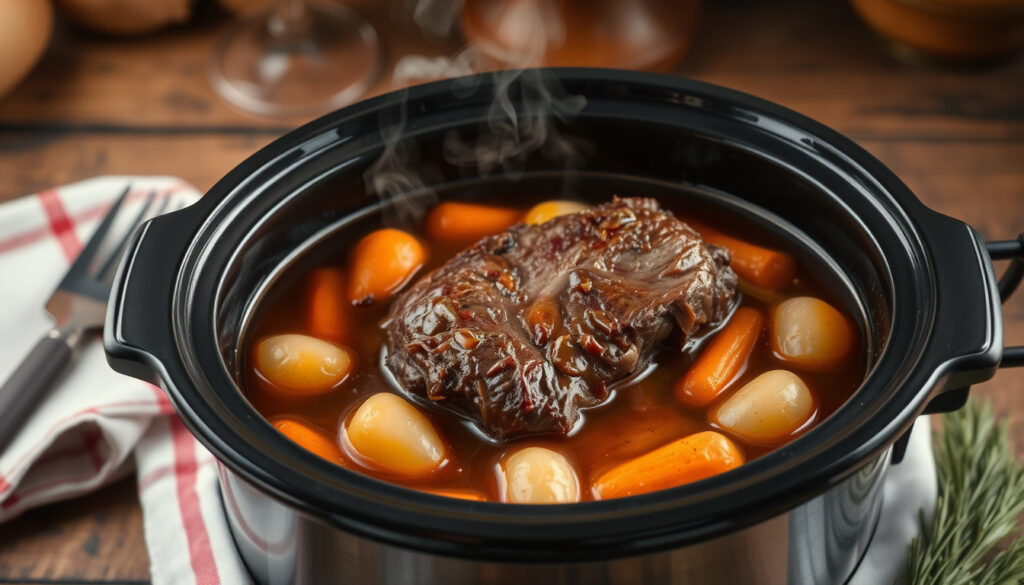
Crock Pot Pot Roast: Cooking Time, Mistakes, and Best Liquid
There’s a reason pot roast has been a family dinner staple for generations: it’s forgiving, deeply flavorful, and fills the house with a welcoming aroma. But getting that fall-apart tender meat from a crock pot isn’t automatic — it depends on timing, cut choice, and a few key techniques.
Recommended cooking time (low): 8-10 hours ·
Recommended cooking time (high): 4-6 hours ·
Best cut of beef: Chuck roast ·
Ideal internal temperature: 190-200°F (88-93°C) ·
Common liquid base: Beef broth or stock ·
Browning step: Optional but recommended
Quick snapshot
- Browning improves flavor (Casa de Crews)
- Cooking on low yields tender meat (The Cozy Cook)
- Chuck roast is best (Elizabeth Rider)
- Exact time varies by slow cooker model (Cooking Classy)
- Whether to add vegetables at start or end (The Food Charlatan)
- Low: 8-10 hours, High: 4-6 hours (The Cozy Cook)
- Check for fork-tender shredding at 190-200°F (Casa de Crews)
Six key facts at a glance: one pattern — consistent low heat transforms tough collagen into gelatin, making the roast tender.
| Label | Value |
|---|---|
| Best cut | Chuck roast |
| Cooking time (low) | 8-10 hours |
| Cooking time (high) | 4-6 hours |
| Internal temp target | 190-200°F |
| Common liquid | Beef broth |
| Browning | Recommended but optional |
How many hours do you cook pot roast in a crock pot?
Cooking on low vs high: time differences
The most consistent answer across recipe sources: 8-10 hours on LOW or 4-6 hours on HIGH. The Cozy Cook gives that standard range, while Cooking Classy targets 8-9 hours on LOW. Elizabeth Rider adjusts for roast size: a 4-5 lb roast needs 6-8 hours on LOW, 4-6 hours on HIGH. The Food Charlatan explicitly warns against cooking on HIGH for 4-5 hours, saying the result will be less tender than low-and-slow cooking.
If you must use HIGH, Tasting Table notes that the time should be cut to about four hours — but the trade-off is a firmer, less shreddable texture.
Signs of doneness: fork-tender
The universal doneness test: the meat should shred easily with two forks. Casa de Crews describes it as “fork-tender.” An internal temperature of 190-200°F (88-93°C) is the scientific target — that’s when collagen fully breaks down into gelatin. The Cozy Cook adds that opening the lid during cooking can add about 30 minutes to the cook time, so resist the urge to peek.
Lifting the lid even once can cost you 20-30 minutes of cooking time. That’s not a myth — it’s thermodynamics. Each peek releases built-up steam and forces the slow cooker to reheat from scratch.
The implication: trust the time range, but verify with a fork. If the roast resists shredding, it needs more time — even if the clock says 8 hours.
What are common mistakes when making crock pot roast?
Overcooking or undercooking
Too little time and the meat is tough; too much and it becomes dry and stringy. The sweet spot is when the internal temperature hits 190-200°F. Rachael’s Good Eats advises cooking longer if the roast is not falling apart, but warns that drying out becomes a real risk after 10 hours on LOW.
Using the wrong cut of meat
Chuck roast is the undisputed champion. Elizabeth Rider explains that chuck has enough intramuscular fat and connective tissue to survive hours of heat without drying out. Lean cuts like sirloin or round will turn into shoe leather.
Skipping the browning step
Browning (searing) the roast before adding it to the slow cooker is optional but transformative. Casa de Crews notes that many recipes call for it. The Maillard reaction creates deep, savory compounds that deglazing with broth pulls into the final gravy. Without it, the roast is still tender — but significantly less flavorful.
Too much liquid
Pot roast is braised, not boiled. Casa de Crews uses 2 cups of beef broth and emphasizes that potatoes should be fully covered, adding extra broth or water if needed. Drowning the meat dilutes the flavor and makes the gravy watery. Amanda’s Cookin’ recommends 7-8 hours on LOW with a moderate liquid level.
More liquid means more steam, which can slow down browning reactions inside the pot. The goal is to barely cover the meat, not submerge it.
What this means: the most common mistakes all stem from impatience or cheap cuts. Stick with chuck, brown it if you can, keep the liquid moderate, and don’t rush the cooking time.
What liquid do you use for pot roast in a crock pot?
Beef broth and stock
Beef broth is the default liquid for pot roast. Cooking Classy uses it as the base, along with onions, carrots, and potatoes. Casa de Crews specifies 2 cups of beef broth, adding more if needed to cover the vegetables.
Red wine
A splash of red wine adds acidity and depth. The acidity helps break down connective tissue and balances the richness of the meat. Most recipes don’t specify a wine type, but a dry red like Cabernet Sauvignon or Merlot works well. The Cozy Cook includes wine as an optional ingredient in its roast recipe.
Tomato paste and Worcestershire
Tomato paste adds umami and a slight tang, while Worcestershire sauce brings savory complexity. These are common additions in many slow-cooker pot roast recipes, though they are not always listed as essential. They boost the overall flavor profile without adding extra liquid volume.
Avoid water
Plain water lacks the flavor and body needed for a rich gravy. Tasting Table identifies using too much liquid as a mistake, and water is the worst choice because it contributes nothing to taste. Stick with broth, and if you must thin it, use a mix of broth and wine.
The pattern: the best liquid strategy is a combination of beef broth (for savory base) and a small amount of wine or tomato paste (for acidity and depth). Avoid water entirely.
Can you put a raw roast in a crock pot?
Safety considerations
Yes, you can put a completely raw roast into a slow cooker. The USDA recommends cooking beef roasts to a minimum internal temperature of 145°F for safety, but for pot roast you’ll be cooking well beyond that (to 190-200°F) to break down collagen. As long as the slow cooker reaches a safe temperature (above 140°F within two hours), it’s safe. Food.com offers a recipe that starts with raw meat and cooks on LOW for 7 hours.
Flavor impact of browning
Skipping browning is safe, but you lose the Maillard reaction — the browning that creates hundreds of flavor compounds. Casa de Crews notes that recipes often call for searing first. Without it, the roast will be tender but less rich. The choice is between convenience and depth of flavor.
Texture differences
Raw meat placed directly in the slow cooker will still become tender over 8-10 hours, but the surface may lack the crust that searing provides. The Food Charlatan recommends browning for the best texture and flavor. The difference is subtle but noticeable to anyone who cooks both ways.
Why this matters: if you’re short on time, raw is fine. If you have 10 extra minutes, searing is the single highest-impact upgrade for flavor.
How do you make a 3 ingredient roast in a slow cooker?
Ingredients: chuck roast, onion soup mix, broth
The three-ingredient crock pot roast is a classic shortcut: a 3-4 lb chuck roast, one packet of dry onion soup mix, and 1 cup of beef broth. Food.com has a version that uses these core ingredients. The onion soup mix provides salt, herbs, and a savory base.
Step-by-step instructions
- Place the chuck roast in the slow cooker.
- Sprinkle the dry onion soup mix evenly over the roast.
- Pour in 1 cup of beef broth. Do not stir.
- Cover and cook on LOW for 8 hours (or HIGH for 4-5 hours).
- Check for fork-tenderness. If the meat shreds easily, it’s done.
- Remove the roast, shred or slice, and serve with the cooking juices.
Tips for best results
Even with three ingredients, success depends on the cut. Elizabeth Rider emphasizes that chuck roast is non-negotiable. Rachael’s Good Eats adds that if the roast is not falling apart, cook it longer – but don’t rush it. The soup mix can be salty, so consider low-sodium broth.
The trade-off: three ingredients are convenient, but you sacrifice the depth that browning and aromatics provide. For a quick weeknight dinner, it’s a solid choice.
Step-by-Step Guide to Perfect Crock Pot Pot Roast
Follow these steps for a consistently tender, flavorful pot roast every time.
- Choose the right cut. Buy a 3-4 lb chuck roast with good marbling.Elizabeth Rider confirms chuck is best.
- Season and sear (optional). Pat the roast dry, season with salt and pepper, and sear in a hot skillet with oil until browned on all sides. Casa de Crews notes this step is common.
- Add aromatics. Place chopped onions, carrots, and garlic in the slow cooker. Cooking Classy uses this base.
- Add liquid. Pour in 1-2 cups of beef broth. Add a splash of red wine or a tablespoon of tomato paste if desired. The Cozy Cook includes wine.
- Cook low and slow. Cover and cook on LOW for 8-10 hours, or on HIGH for 4-6 hours. The Cozy Cook gives these ranges.
- Check doneness. The roast should shred easily with two forks. Casa de Crews calls this fork-tender.
- Rest and serve. Let the roast rest for 10 minutes before shredding. Skim fat from the juices or thicken into gravy.
The pattern: patience and the right cut are the two non-negotiable pillars. Everything else is optional.
What We Know and What’s Still Unclear
Confirmed facts
- Browning improves flavor significantly (Casa de Crews)
- Cooking on LOW yields more tender meat than HIGH (The Food Charlatan)
- Chuck roast is the best cut for slow cooking (Elizabeth Rider)
- Internal temp of 190-200°F ensures collagen breakdown (Casa de Crews)
What’s unclear
- Exact cook time varies by slow cooker model and size (Cooking Classy)
- Whether to add vegetables at the start or later in the cook (The Food Charlatan adds carrots 3 hours before serving)
- Optimal liquid ratio for different slow cooker sizes (some sources say cover vegetables, others say moderate)
- Whether HIGH setting can ever match LOW tenderness for larger roasts (Amanda’s Cookin’ says HIGH is less tender)
Expert Perspectives
“Cook beef roasts to at least 145°F for safety, but for pot roast you’ll be cooking to 190-200°F to break down collagen.”
“Opening the lid during cooking can lose a lot of heat and add about 30 minutes to the cook time.”
The Cozy Cook (recipe developer)
The upshot: both the USDA and experienced home cooks agree that low-and-slow is the only reliable path to tender pot roast, and that peeking has real consequences.
To avoid ending up with dry or mushy meat, it helps to review common pot roast mistakes that can ruin a slow-cooked roast.
Frequently asked questions
Can I use a different cut of beef?
Chuck roast is the best choice. Other cuts like brisket or bottom round can work but may be less tender. Lean cuts like sirloin will dry out. Elizabeth Rider recommends chuck for its fat content.
Should I peel potatoes before adding to crock pot?
Peeling is optional. Unpeeled potatoes hold their shape better during long cooking, but peeled potatoes absorb more flavor. Casa de Crews doesn’t specify peeling, but many recipes leave skins on.
How do I prevent the roast from being dry?
Use a well-marbled chuck roast, don’t overcook (check internal temp), and keep the liquid level moderate. Rachael’s Good Eats advises cooking until fork-tender but not longer.
Can I add frozen vegetables?
Yes, but frozen vegetables release water and can make the dish watery. Add them in the last 30 minutes of cooking to avoid mushiness. The Food Charlatan adds carrots mid-cook.
What size crock pot do I need?
A 5-6 quart slow cooker is ideal for a 3-4 lb roast. A 3-4 quart cooker may cook faster, while a 7-quart model may need a bit more liquid. Cooking Classy uses a 6-quart.
Can I cook pot roast on high for 4 hours?
Yes, but the meat will be less tender than low-and-slow cooking. The Food Charlatan advises against it. If you must, use a smaller roast and monitor closely.
How do I make gravy from the juices?
Strain the cooking liquid, skim off fat, and whisk in a slurry of cornstarch or flour (2 tablespoons per cup of liquid). Simmer until thickened. The Cozy Cook has a gravy method.
Can I reheat pot roast in the slow cooker?
Yes, reheat on LOW for 1-2 hours. Add a splash of broth if the meat seems dry. Rachael’s Good Eats recommends reheating gently.
For anyone who’s ever struggled with a dry or tough pot roast, the implication is clear: choose chuck, give it 8 hours on low, and don’t touch the lid. The difference between a good pot roast and a great one is almost always patience, not technique.
More related posts
 AD Love Is Blind: Baby, Marriage, and Clay Rejection
 How Old is Keanu Reeves? His Age, Bio, Partner & Facts
 How to Remove Oil Stains from Clothes (Even After Drying)
 Easy Chicken Breast Recipes: 5 Simple Ways for Juicy Results
 UEFA Champions League: Fixtures 2025/26, Matches Today
 The Good, the Bad and the Ugly: Message, Quotes & Watch Order
 2/3 Cup – Tbsp, Grams, Oz Conversions
 How Old Is Sylvester Stallone? Age, Health, Family & More